
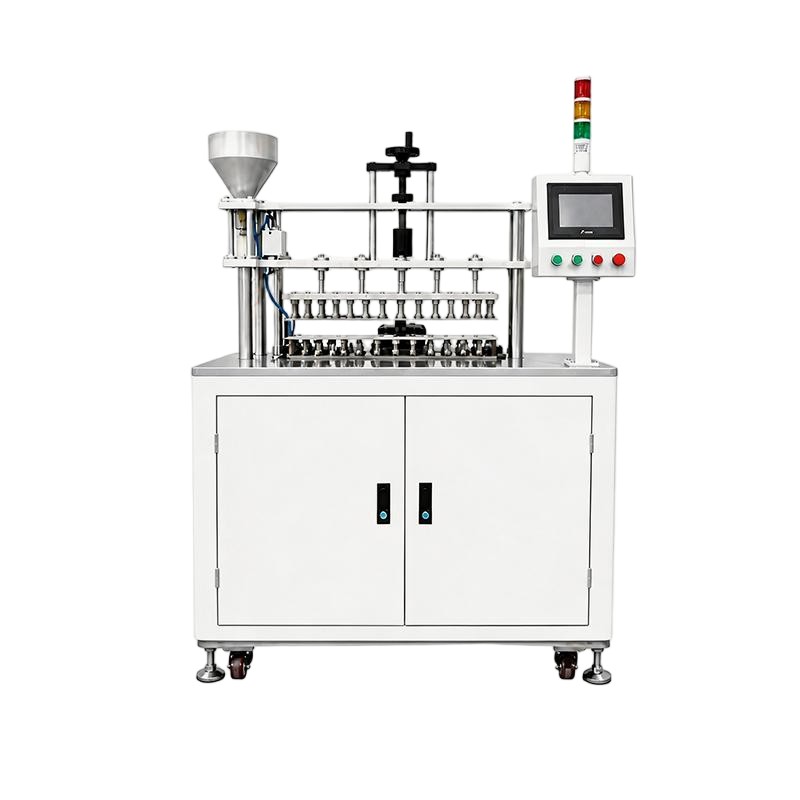
Heat Pipe Production Line: Complete Manufacturing Guide
1. What Is a Heat Pipe Production Line?
A Heat Pipe Production Line is a manufacturing system for producing sealed heat transfer components. It combines several machines to complete different production operations.
Depending on product design, the system may include:
- Copper tube cutting equipment
- Tube cleaning equipment
- Powder filling machines
- Vacuum sintering furnaces
- Heat pipe forming equipment
- Necking machines
- Drying and degassing equipment
- Working fluid filling systems
- Filling and welding machines
- Leak testing equipment
- Thermal performance testing equipment
Each machine performs a specific manufacturing task. Together, they support a controlled and repeatable production process.
However, not every heat pipe requires identical equipment. The required configuration depends on tube dimensions, wick structures, working fluids, and product applications.
For example, sintered copper wick heat pipes require powder preparation and sintering. Grooved and mesh wick products use different manufacturing methods.
Therefore, manufacturers should select equipment according to their actual product designs.
2. How Does a Heat Pipe Work?
Before selecting a Heat Pipe Production Line, manufacturers should understand heat pipe operation.
A heat pipe transfers heat through a sealed working fluid. Its internal structure usually contains three main components.
2.1 Evaporator Section
The evaporator section receives heat from an external source. The working fluid absorbs energy and changes into vapor.
As a result, the vapor moves toward the cooler section.
2.2 Condenser Section
The condenser section releases heat into the surrounding environment. The vapor loses energy and condenses into liquid.
Consequently, the working fluid returns toward the evaporator.
2.3 Wick Structure
The wick structure helps return liquid through capillary action. Common wick designs include:
- Sintered powder wick
- Grooved wick
- Mesh wick
- Composite wick
Each structure offers different capillary and thermal characteristics.
For instance, sintered copper powder wicks provide a porous structure. Their performance depends on particle size, porosity, pore distribution, and manufacturing conditions.
Manufacturers must therefore match wick preparation processes with the intended heat pipe design.
3. Main Heat Pipe Manufacturing Processes
A complete Heat Pipe Production Line follows several coordinated manufacturing stages. However, the exact sequence depends on the heat pipe structure.
3.1 Copper Tube Cutting
First, manufacturers cut copper tubes to the required dimensions. Accurate cutting helps maintain consistent product lengths.
Furthermore, suitable cutting equipment reduces deformation and improves processing efficiency.
The cutting process should consider:
- Tube diameter
- Tube wall thickness
- Required cutting length
- Material characteristics
- Production volume
After cutting, operators should inspect the tube ends. Burrs and deformation may affect later manufacturing operations.
3.2 Tube Cleaning and Preparation
Next, manufacturers clean the copper tubes. This process removes oil, dust, metal particles, and other contaminants.
Clean internal surfaces support reliable wick preparation and product assembly.
Additionally, manufacturers should control the cleaning and drying processes. Residual contaminants may affect internal cleanliness.
3.3 Wick Structure Preparation
The wick structure plays an important role in heat pipe performance. Therefore, manufacturers must select suitable preparation methods.
For sintered powder wicks, copper powder enters the tube before sintering. The powder forms a porous structure under controlled heating conditions.
For other designs, manufacturers may insert mesh or create internal grooves.
The preparation method depends on the product’s thermal requirements and structural design.
3.4 Powder Filling
Powder filling applies to heat pipes that use sintered powder wicks.
A [Heat Pipe Powder Filling Machine] distributes copper powder inside the tube. Consistent powder distribution helps establish the intended wick structure.
Important process factors include:
- Powder particle characteristics
- Filling quantity
- Powder distribution
- Tube dimensions
- Filling consistency
Manufacturers should also control powder cleanliness. Contamination may affect the resulting porous structure.
3.5 Vacuum Sintering
After powder filling, suitable products enter a sintering process.
A [Vacuum Sintering Furnace] heats the copper powder under controlled conditions. This process bonds powder particles and forms a porous wick.
However, sintering parameters depend on powder characteristics and product design.
Manufacturers should evaluate porosity, mechanical integrity, and capillary performance. These factors help determine whether the wick meets design requirements.
3.6 Forming and Necking
Some heat pipe designs require forming or necking operations.
These processes shape the tube and prepare its ends for subsequent manufacturing steps.
A [Heat Pipe Necking Machine] can reduce the tube diameter at specified positions. This operation supports different sealing and assembly requirements.
Manufacturers should control deformation carefully. Excessive deformation may damage internal structures or affect tube dimensions.
3.7 Drying and Vacuum Degassing
Drying and degassing help prepare the internal space before working fluid filling.
Moisture and non-condensable gases can reduce heat pipe performance. Therefore, manufacturers need suitable process controls.
A [Heat Pipe Multi-station Dry-out Tester] supports drying-related process operations, depending on its configuration.
Meanwhile, a [Heat Pipe Vacuum Degassing Machine] supports vacuum treatment and gas removal.
These processes serve different purposes. Manufacturers should define suitable parameters for their materials and product structures.
3.8 Working Fluid Filling
After internal preparation, manufacturers introduce the specified working fluid.
The fluid type and quantity depend on the heat pipe design. Common choices include water and other compatible working fluids.
Filling accuracy matters because an incorrect charge may affect thermal performance.
Therefore, manufacturers should establish suitable filling procedures. They should also maintain consistent process records.
3.9 Filling and Welding
After working fluid filling, manufacturers seal the heat pipe.
A [Heat Pipe Filling & Welding Machine] can integrate filling and sealing operations. The specific process depends on the machine configuration.
Suitable welding parameters help create reliable joints. Meanwhile, manufacturers should consider tube material, wall thickness, and joint geometry.
3.10 Leak Testing and Thermal Performance Testing
Finally, manufacturers inspect the finished heat pipes.
Leak testing checks whether the sealed product maintains its required integrity. Thermal performance testing evaluates heat transfer behavior under defined conditions.
A [Heat Pipe Thermal Performance Tester] helps manufacturers assess product performance.
However, leak testing and thermal testing are different procedures. Both may be necessary for comprehensive quality control.
4. Essential Heat Pipe Production Equipment
A suitable Heat Pipe Production Line requires equipment that matches the product structure and manufacturing process.
The following table summarizes common equipment and its main functions.
Equipment | Main Function | Applicable Process |
Copper Tube Cutting Machine | Cuts tubes to specified lengths | Tube preparation |
Tube Cleaning Equipment | Removes surface and internal contaminants | Cleaning |
Heat Pipe Powder Filling Machine | Fills copper powder into tubes | Sintered wick preparation |
Vacuum Sintering Furnace | Forms porous powder wick structures | Sintering |
Heat Pipe Necking Machine | Reduces tube diameter at selected positions | Tube forming |
Dry-out Equipment | Supports internal drying processes | Drying |
Vacuum Degassing Machine | Removes gases through vacuum treatment | Degassing |
Heat Pipe Filling & Welding Machine | Fills working fluid and seals tubes | Filling and sealing |
Leak Testing Equipment | Checks sealing integrity | Quality inspection |
Thermal Performance Tester | Evaluates heat transfer performance | Final inspection |
Manufacturers do not always need every machine listed above. Instead, they should build the equipment configuration around their product requirements.
For example, sintered wick products need powder filling and sintering equipment. Other wick structures require different preparation systems.
5. How to Configure a Complete Production Line
Choosing the right equipment requires careful production planning. Manufacturers should evaluate several factors before purchasing machines.
5.1 Define Product Specifications
First, identify the heat pipe products you plan to manufacture.
Consider the following parameters:
- Tube material
- Tube diameter
- Tube length
- Wall thickness
- Wick structure
- Working fluid
- Product shape
- Required thermal performance
These specifications determine the necessary manufacturing processes.
5.2 Determine Production Capacity
Next, estimate the required production volume.
A small factory may prioritize flexible equipment. However, larger manufacturers may require automated material handling and multi-station processing.
Production planning should consider:
- Daily production targets
- Working hours
- Product changeover frequency
- Operator availability
- Inspection requirements
Furthermore, manufacturers should consider future capacity expansion.
5.3 Select Compatible Machines
Each machine should match the dimensions and processing requirements of the product.
For example, powder filling equipment must accommodate the intended tube dimensions. Likewise, welding equipment must support the required joint structure.
Manufacturers should also evaluate machine compatibility. Consistent interfaces can simplify material transfer between processes.
5.4 Plan the Factory Layout
A practical factory layout improves workflow and material movement.
Ideally, production should follow a logical sequence. This arrangement reduces unnecessary handling and intermediate storage.
Manufacturers should also reserve space for inspection stations. In addition, they should consider ventilation, power supply, cooling, and maintenance access.
5.5 Consider Automation Requirements
Automation can improve process consistency and reduce repetitive manual work.
However, the appropriate automation level depends on production volume and investment plans.
For example, manufacturers may automate powder filling, vacuum treatment, or working fluid filling. They can also integrate inspection systems where suitable.
6. Benefits of an Automated Heat Pipe Production Line
An integrated Heat Pipe Production Line offers several manufacturing advantages.
6.1 Improved Production Consistency
Automated equipment helps maintain repeatable process conditions. Consequently, manufacturers can reduce variations between production batches.
This benefit matters when supplying customers with strict quality requirements.
6.2 Higher Production Efficiency
Integrated equipment reduces unnecessary manual handling. Furthermore, automated processes can shorten production cycles.
Manufacturers can organize different operations more efficiently. As a result, production planning becomes easier.
6.3 Better Process Control
Modern equipment can support controlled temperature, vacuum, filling, and welding parameters.
Therefore, operators can monitor important manufacturing conditions more systematically.
Consistent process records also support production analysis.
6.4 Reduced Manual Work
Automation reduces repetitive manual operations. This can help manufacturers improve workplace organization.
Meanwhile, operators can focus on monitoring, inspection, and process optimization.
6.5 Flexible Manufacturing
A properly configured production system can support different heat pipe models.
However, flexibility depends on machine design and changeover requirements.
Manufacturers should confirm compatible product ranges before purchasing equipment.
7. Applications of Heat Pipe Products
Heat pipes support thermal management across many industries. Their applications continue to expand as electronic devices become more powerful.
Consumer Electronics
Heat pipes help transfer heat inside laptops, tablets, and compact electronic devices. They support temperature management in limited spaces.
Computer and Server Cooling
High-performance processors generate significant heat during operation. Heat pipes help distribute this heat toward cooling components.
They often work with heat sinks and fans.
Telecommunications Equipment
Telecommunications systems require stable thermal management. Heat pipes can support cooling in communication cabinets and electronic modules.
Automotive Electronics
Modern vehicles contain many electronic control systems. Heat pipes can support thermal management in selected automotive applications.
Industrial Equipment
Industrial power electronics and control systems also require reliable heat dissipation. Heat pipes provide another option for thermal management design.
These applications create opportunities for manufacturers. However, each application requires suitable product testing and validation.
8. How to Choose Heat Pipe Manufacturing Equipment
Selecting a reliable equipment supplier affects long-term manufacturing performance.
Therefore, manufacturers should evaluate more than the initial purchase price.
8.1 Equipment Compatibility
First, confirm whether the equipment supports your product specifications.
Discuss tube dimensions, materials, wick structures, and process requirements. This helps avoid purchasing unsuitable machines.
8.2 Manufacturing Process Experience
A supplier should understand the main stages of heat pipe manufacturing.
This knowledge helps identify suitable equipment combinations. It also supports more practical production planning.
8.3 Automation and Customization
Different factories have different production requirements.
Some manufacturers need individual machines. Others require integrated production systems.
Therefore, evaluate the supplier’s ability to adapt equipment configurations.
8.4 Technical Support
Equipment installation and commissioning require appropriate technical support.
Manufacturers should ask about operation training, maintenance guidance, spare parts, and troubleshooting procedures.
8.5 Future Expansion
Production requirements may change over time.
Therefore, consider whether the equipment configuration supports future expansion. A modular approach may help manufacturers add capacity gradually.
9. Quality Control in Heat Pipe Production
Quality control should cover the entire manufacturing process. Final inspection alone cannot identify every production problem.
9.1 Incoming Material Inspection
First, inspect copper tubes and other raw materials.
Check dimensions, surface condition, and material consistency. Also, verify powder characteristics when manufacturing sintered wick products.
9.2 Wick Structure Inspection
For sintered powder wicks, manufacturers should evaluate relevant structural characteristics.
These may include porosity, pore distribution, and capillary behavior.
Research shows that copper powder particle size and geometry influence porous wick characteristics. Therefore, powder selection and sintering conditions deserve careful attention.
9.3 Vacuum Process Monitoring
Vacuum treatment requires appropriate process monitoring.
Manufacturers should establish suitable procedures for equipment condition, process duration, and gas removal.
A vacuum reading alone does not prove complete removal of non-condensable gases. Additional process validation may be necessary.
9.4 Welding and Sealing Inspection
Sealed joints must meet the product’s integrity requirements.
Manufacturers should inspect welding consistency and conduct suitable leak tests.
The testing method should match the product design and required acceptance criteria.
9.5 Thermal Performance Testing
Thermal testing evaluates heat pipe behavior under defined operating conditions.
Manufacturers may assess thermal resistance, heat transfer capability, and temperature distribution.
However, test conditions must reflect the intended application. Otherwise, results may not represent actual operating performance.
10. Common Production Challenges and Solutions
Heat pipe manufacturers may encounter several production difficulties.
Common Challenge | Possible Cause | Suggested Solution |
Uneven powder distribution | Inconsistent filling process | Optimize powder filling parameters |
Unstable wick structure | Incorrect powder or sintering conditions | Evaluate powder characteristics and sintering procedures |
Residual moisture | Insufficient drying | Improve drying process control |
Non-condensable gases | Inadequate degassing | Review vacuum treatment and validation |
Welding defects | Unsuitable welding parameters | Optimize welding conditions |
Leakage | Defective joints or sealing | Improve sealing control and leak inspection |
Inconsistent thermal results | Variable filling or wick quality | Strengthen process monitoring and testing |
These problems often involve multiple manufacturing factors. Therefore, manufacturers should investigate the complete process rather than changing one parameter blindly.
11. Why Choose Linkthermal?
Linkthermal provides equipment solutions for heat pipe and vapor chamber manufacturing.
The company focuses on manufacturing equipment and production process requirements. Its solutions support manufacturers seeking suitable equipment configurations.
When planning a Heat Pipe Production Line, manufacturers should consider both individual machines and their overall compatibility.
Linkthermal can be considered for equipment requirements involving:
- Heat pipe powder filling
- Vacuum sintering
- Heat pipe necking
- Dry-out processing
- Vacuum degassing
- Working fluid filling
- Filling and welding
- Thermal performance testing
Different products require different machine combinations. Therefore, manufacturers should confirm their product specifications before selecting equipment.
Visit the official website to explore available solutions:
Linkthermal – Heat Pipe and Vapor Chamber Manufacturing Equipment
12. Frequently Asked Questions
Q1. What machines are needed for a Heat Pipe Production Line?
A typical line may include tube cutting, cleaning, wick preparation, drying, degassing, filling, welding, and inspection equipment.
However, the exact configuration depends on the product design.
Q2. What is the main process in heat pipe manufacturing?
The main processes include tube preparation, wick formation, internal cleaning, drying, vacuum treatment, fluid filling, and sealing.
Manufacturers then conduct leak and thermal performance tests.
Q3. Does every heat pipe require a powder filling machine?
No. Powder filling mainly applies to heat pipes with sintered powder wick structures.
Grooved and mesh wick designs use different preparation methods.
Q4. What does a vacuum sintering furnace do?
A vacuum sintering furnace forms porous wick structures from metal powder.
Controlled heating bonds powder particles while maintaining the required porous structure.
Q5. Why is vacuum degassing important?
Vacuum degassing helps remove gases from the internal space.
Non-condensable gases can interfere with heat pipe operation. Therefore, manufacturers need suitable degassing procedures.
Q6. What is the difference between dry-out and vacuum degassing?
Dry-out focuses on removing moisture and other volatile substances. Vacuum degassing focuses on removing gases through vacuum treatment.
Both processes support internal preparation, but they serve different purposes.
Q7. Why does a heat pipe need leak testing?
Leak testing checks the integrity of the sealed structure.
A leak may cause working fluid loss and reduce product reliability. Therefore, manufacturers should establish suitable inspection procedures.
Q8. How do manufacturers choose a suitable production line?
Manufacturers should consider tube dimensions, wick structure, working fluid, production capacity, and quality requirements.
They should also evaluate automation needs and future expansion plans.
Q9. Can one production line manufacture different heat pipe models?
Some equipment can support multiple product models. However, compatibility depends on machine design and changeover requirements.
Manufacturers should confirm the supported product range with the equipment supplier.
Q10. What factors affect heat pipe manufacturing quality?
Important factors include material quality, wick structure, cleanliness, drying, degassing, filling accuracy, and sealing quality.
Consistent process control helps improve manufacturing stability.
13. Conclusion
A well-designed Heat Pipe Production Line supports efficient and consistent heat pipe manufacturing.
It combines specialized equipment with controlled production processes. Each stage contributes to the final product’s quality and thermal performance.
However, manufacturers should not select equipment without considering product structure. Different wick designs and product specifications require different manufacturing methods.
Therefore, start with clear product requirements and production targets. Then select compatible machines and establish suitable inspection procedures.
Linkthermal provides heat pipe manufacturing equipment solutions for different production requirements. Visit https://linkthermal.com/ to explore equipment options and plan your manufacturing system.