
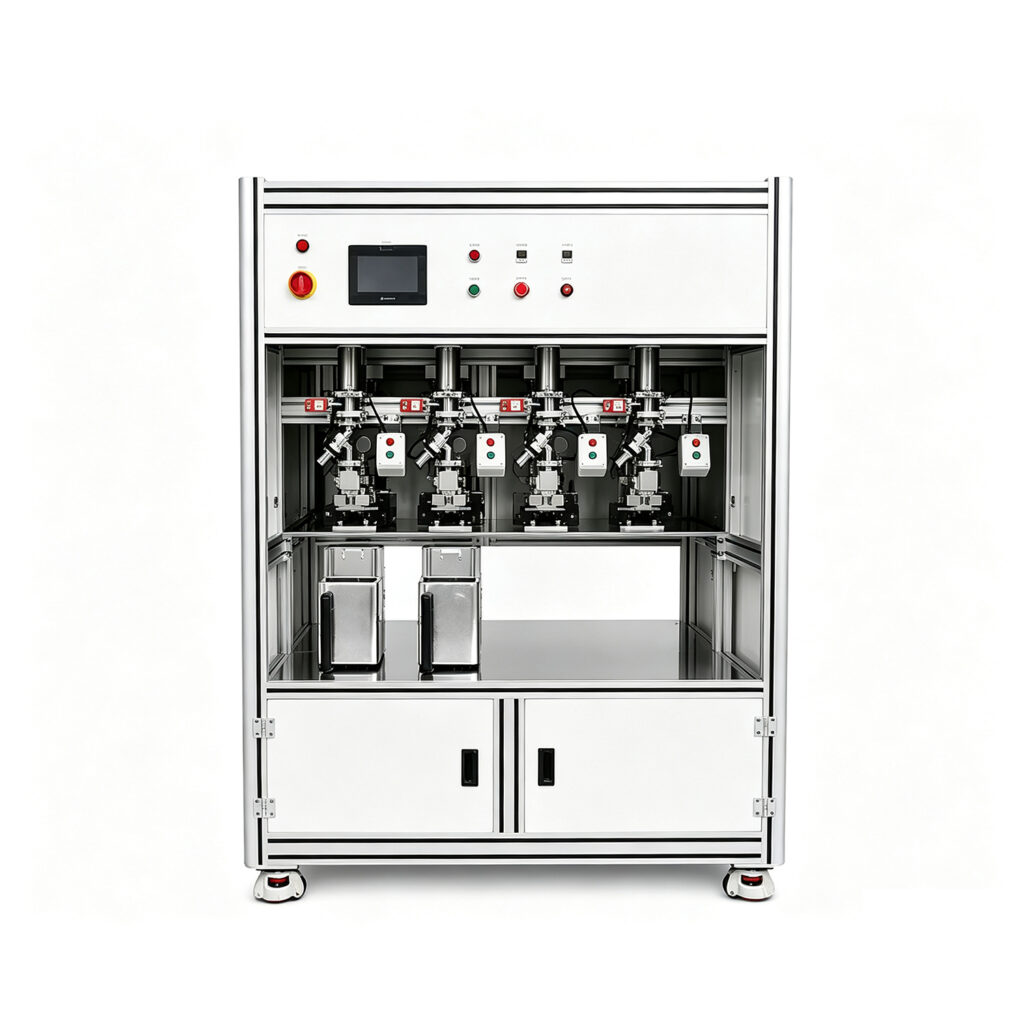
Heat Pipe Equipment Production Line: Complete Guide
1. What Is a Heat Pipe Equipment Production Line?
A Heat Pipe Equipment Production Line is an integrated manufacturing system. It uses specialized machines to produce heat pipes through multiple processing stages.
A typical system may include:
- Tube cutting and preparation equipment
- Heat Pipe Necking Machine
- Heat Pipe Powder Filling Machine
- Vacuum Sintering Furnace
- Heat Pipe Vacuum Degassing Machine
- Heat Pipe Filling & Welding Machine
- Heat Pipe Multi-station Dry-out Tester
- Heat Pipe Thermal Performance Tester
Each machine performs a specific manufacturing operation. Together, they support the complete production workflow.
However, the exact equipment configuration depends on product requirements. Different heat pipe designs may require different processing methods.
For example, sintered powder wick structures need powder filling and sintering equipment. Other wick structures may require different manufacturing processes.
Therefore, manufacturers should define their product specifications before purchasing equipment.
2. Why Is Specialized Heat Pipe Equipment Important?
Heat pipes transfer thermal energy through evaporation and condensation. Their internal structures directly influence heat transfer performance.
A typical heat pipe contains three main components:
- A sealed metal enclosure
- An internal wick structure
- A suitable working fluid
During operation, the working fluid absorbs heat and evaporates. The vapor then moves toward the cooler condenser section.
Next, the vapor releases heat and condenses. The wick structure returns liquid toward the evaporator section.
This cycle supports continuous heat transfer.
However, manufacturing these components requires controlled processes. Inconsistent powder filling, unsuitable sintering conditions, or poor sealing can affect product performance.
Specialized heat pipe equipment helps manufacturers control important production operations. It also supports repeatable processing and more consistent inspection.
Furthermore, integrated equipment can reduce unnecessary material handling. This may improve production coordination and workflow management.
3. Main Machines in a Heat Pipe Equipment Production Line
A complete production line may contain several specialized machines. Manufacturers should select each machine according to the required manufacturing process.
3.1 Heat Pipe Necking Machine
Internal link opportunity: Heat Pipe Necking Machine
The necking machine reduces the diameter of selected tube sections. It helps create the required geometry for subsequent processing.
Accurate necking supports dimensional consistency. In addition, suitable tooling helps maintain repeatable forming results.
When selecting this machine, manufacturers should consider:
- Tube material
- Initial tube diameter
- Target necking diameter
- Wall thickness
- Required forming length
- Tooling requirements
These parameters help determine the suitable machine configuration.
3.2 Heat Pipe Powder Filling Machine
Internal link opportunity: Heat Pipe Powder Filling Machine
The powder filling machine introduces wick material into the heat pipe. This process requires suitable control of material quantity and distribution.
For sintered wick structures, powder characteristics influence the manufacturing process. Therefore, manufacturers should evaluate powder properties and tube dimensions.
Consistent filling helps establish suitable conditions for the next processing stage.
3.3 Vacuum Sintering Furnace
Internal link opportunity: Vacuum Sintering Furnace
The vacuum sintering furnace processes the wick material under controlled heating conditions. It helps form the porous internal structure.
Temperature control plays an important role. However, suitable parameters depend on powder composition and product design.
Manufacturers should evaluate the furnace’s temperature range, working capacity, and process control features.
3.4 Heat Pipe Vacuum Degassing Machine
Internal link opportunity: Heat Pipe Vacuum Degassing Machine
The vacuum degassing machine removes unwanted gases from the heat pipe. This operation prepares the internal space for working-fluid filling.
Vacuum conditions influence the degassing process. Therefore, manufacturers should check vacuum performance and process stability.
The required configuration depends on tube dimensions and production requirements.
3.5 Heat Pipe Filling & Welding Machine
Internal link opportunity: Heat Pipe Filling & Welding Machine
This machine supports working-fluid filling and tube sealing. Both operations require suitable process control.
The filling quantity depends on the heat pipe design. Meanwhile, welding parameters depend on tube material and joint requirements.
Manufacturers should evaluate filling accuracy, welding consistency, and product compatibility.
3.6 Heat Pipe Multi-station Dry-out Tester
Internal link opportunity: Heat Pipe Multi-station Dry-out Tester
Dry-out testing evaluates heat pipe behavior under defined thermal conditions. It helps identify potential limitations during operation.
A multi-station tester can evaluate several samples within one system. Consequently, it may support more efficient inspection workflows.
The actual testing capacity depends on the equipment configuration.
3.7 Heat Pipe Thermal Performance Tester
Internal link opportunity: Heat Pipe Thermal Performance Tester
Thermal performance testing evaluates the heat transfer characteristics of finished products. It helps manufacturers assess product performance against defined requirements.
Testing conditions should reflect the intended application. Therefore, manufacturers should establish suitable measurement methods and operating parameters.
4. How Does the Manufacturing Process Work?
A Heat Pipe Equipment Production Line supports several connected manufacturing stages. The exact sequence depends on the product structure and production method.
Step 1: Tube Preparation
First, manufacturers select suitable tube materials. Copper tubes are common in many heat pipe applications.
Next, operators or machines cut tubes to the required dimensions. The manufacturer then prepares the tube ends for subsequent processing.
Step 2: Tube Forming and Necking
The next stage establishes the required tube geometry. Necking equipment reduces selected tube sections.
Some products may also require bending or flattening. These operations depend on the final product design.
Step 3: Powder Filling
For sintered wick structures, the manufacturer fills the tube with suitable powder material.
The filling process should match the product design. In addition, manufacturers should control material quantity and distribution.
Step 4: Vacuum Sintering
After powder filling, the tube enters the sintering process. The furnace applies controlled heating conditions.
This process forms the porous wick structure. Suitable parameters depend on material characteristics and product specifications.
Step 5: Vacuum Degassing
Next, the manufacturer removes unwanted gases from the internal space. Vacuum equipment supports this operation.
This stage prepares the heat pipe for working-fluid filling.
Step 6: Working-Fluid Filling
The manufacturer introduces the specified working fluid into the heat pipe. The required quantity depends on product design.
Suitable filling control helps maintain consistent manufacturing conditions.
Step 7: Welding and Sealing
After filling, the manufacturer seals the tube. The welding process must meet the required joint and sealing standards.
Suitable inspection procedures help identify potential defects.
Step 8: Testing and Inspection
Finally, manufacturers inspect the finished heat pipes. Testing may include leak checks and thermal performance evaluation.
The inspection plan should follow product specifications and application requirements.
5. Different Production Line Configurations
Different manufacturers have different production targets. Therefore, a Heat Pipe Equipment Production Line can use several configurations.
5.1 Semi-automatic Production Line
A semi-automatic system combines automated machines with manual operations. Operators handle selected loading, transfer, and inspection tasks.
This configuration may suit manufacturers with multiple product models. It can also support gradual production development.
However, manual operations require clear procedures. Operator training also helps maintain process consistency.
5.2 Automatic Production Line
An automatic system integrates multiple manufacturing operations. Depending on the design, it may include automated feeding, transfer, processing, and inspection.
This arrangement can reduce manual handling. It may also support more consistent production workflows.
Nevertheless, manufacturers should evaluate the investment against actual production demand.
5.3 Customized Production Line
A customized system addresses specific product requirements. It may support special tube dimensions, wick structures, or production processes.
For example, manufacturers producing different heat pipe models may need flexible tooling. They may also require different filling and testing configurations.
Therefore, customization should begin with product drawings and technical specifications.
6. Key Technical Factors for Equipment Selection
Selecting suitable equipment requires detailed product information. Manufacturers should review several technical factors before requesting quotations.
6.1 Tube Dimensions and Materials
Tube material and dimensions affect equipment compatibility. Manufacturers should provide the following information:
- Tube material
- Tube diameter
- Tube length
- Wall thickness
- Forming requirements
- Finished product dimensions
These details help suppliers evaluate machine suitability.
6.2 Wick Structure
Different wick structures require different manufacturing methods.
Common types include:
- Sintered powder wick structures
- Grooved wick structures
- Mesh wick structures
- Composite wick structures
For example, sintered powder structures require suitable filling and sintering processes.
Therefore, buyers should identify the intended wick structure before equipment selection.
6.3 Working Fluid Requirements
Working-fluid selection depends on the application and operating conditions. The filling process must match the product design.
Manufacturers should provide relevant technical requirements. They should also confirm equipment compatibility with the selected fluid.
6.4 Production Capacity
Production targets influence equipment configuration. Manufacturers should estimate expected daily and monthly output.
They should also consider product changeover time and working hours.
Importantly, the slowest production stage may limit overall line capacity. Therefore, buyers should evaluate the complete workflow.
6.5 Automation Requirements
Automation can reduce manual handling and improve workflow coordination. However, it also affects equipment investment and maintenance requirements.
Manufacturers should identify operations that need automation. Then, they can compare suitable configurations.
7. How to Improve Production Efficiency
Production efficiency depends on equipment performance and process coordination. Manufacturers should evaluate the complete production system.
7.1 Balance Each Production Stage
Each machine should support the required production rhythm. Otherwise, bottlenecks may occur.
For example, insufficient filling capacity may delay downstream operations. Manufacturers should compare the capacity of every critical machine.
7.2 Standardize Operating Procedures
Clear operating procedures help reduce process variation. They also make operator training more effective.
Manufacturers should document important parameters and inspection requirements.
7.3 Reduce Unnecessary Material Handling
Repeated manual transfers can increase production time. They may also create additional handling risks.
A suitable layout can simplify material movement. Therefore, manufacturers should plan machine positions before installation.
7.4 Maintain Equipment Regularly
Regular maintenance helps identify equipment wear. It also supports stable operation.
Manufacturers should establish maintenance schedules for critical components. They should also prepare suitable spare parts.
7.5 Monitor Production Data
Production records help manufacturers identify recurring problems. They can also support process improvement.
Useful records may include:
- Machine operating time
- Production quantity
- Inspection results
- Process parameters
- Equipment maintenance records
- Product rejection rates
8. Quality Control and Product Testing
Quality control should cover every important manufacturing stage. Final inspection alone cannot identify all process problems.
A suitable inspection plan may include the following checkpoints.
Production Stage | Inspection Focus | Main Objective |
Tube preparation | Length and diameter | Dimensional consistency |
Necking | Formed dimensions | Geometry control |
Powder filling | Filling quantity and distribution | Wick consistency |
Sintering | Temperature and process records | Process stability |
Degassing | Vacuum conditions | Internal gas removal |
Fluid filling | Filling quantity | Filling consistency |
Welding | Joint appearance and sealing | Sealing reliability |
Final testing | Leakage and thermal performance | Product evaluation |
8.1 Dimensional Inspection
Manufacturers should inspect tube dimensions after forming. Consistent dimensions support subsequent processing and assembly.
8.2 Leak Testing
Leak testing helps identify potential sealing defects. The selected method should match product requirements.
8.3 Thermal Performance Testing
Thermal performance testing evaluates product behavior under defined conditions. It helps manufacturers assess heat transfer characteristics.
8.4 Process Traceability
Manufacturers should record important production parameters. These records support traceability and continuous improvement.
9. Common Equipment Selection Mistakes
Choosing unsuitable equipment can affect production efficiency and product consistency. Buyers should avoid several common mistakes.
9.1 Selecting Equipment Only by Price
The lowest purchase price does not always represent the best overall value. Buyers should also consider equipment compatibility and maintenance requirements.
9.2 Ignoring Product Specifications
Different heat pipe models may require different processing conditions. Therefore, suppliers need accurate product information.
Without detailed specifications, equipment recommendations may not match actual production needs.
9.3 Overlooking Testing Requirements
Testing equipment plays an important role in quality control. Manufacturers should plan inspection methods before purchasing the production line.
9.4 Ignoring Future Product Development
Some manufacturers expand their product range over time. Therefore, buyers should consider tooling flexibility and possible equipment upgrades.
9.5 Focusing on Individual Machines
A production line requires coordination between different machines. One suitable machine cannot guarantee an efficient overall workflow.
Buyers should evaluate the complete manufacturing process instead.
10. Applications of Heat Pipe Manufacturing Equipment
Heat pipes support thermal management in various industries. Their applications depend on heat loads, product structures, and operating conditions.
10.1 Consumer Electronics
Heat pipes are used in laptops, desktop computers, and other electronic products. They help transfer heat away from concentrated heat sources.
10.2 Telecommunications Equipment
Telecommunications devices generate heat during operation. Heat pipes can support thermal management in suitable system designs.
10.3 Industrial Electronics
Industrial control systems require stable operating temperatures. Heat pipes may help manage heat in compact electronic assemblies.
10.4 LED Lighting
Some LED lighting products use heat pipes for thermal management. Their designs depend on product dimensions and heat dissipation requirements.
10.5 Automotive Electronics
Automotive electronics continue to develop rapidly. Heat pipes may support thermal management in selected applications.
As these industries evolve, manufacturers need suitable production equipment. A properly configured Heat Pipe Equipment Production Line supports consistent manufacturing processes.
11. Why Choose linkthermal Heat Pipe Equipment?
Choosing a supplier requires evaluating equipment range and project requirements. Manufacturers should also consider process compatibility and technical support.
linkthermal focuses on manufacturing equipment for heat pipes and vapor chambers. Its equipment range covers several important production operations.
Relevant equipment includes:
- Heat Pipe Powder Filling Machine
- Heat Pipe Vacuum Degassing Machine
- Heat Pipe Filling & Welding Machine
- Heat Pipe Necking Machine
- Heat Pipe Multi-station Dry-out Tester
- Heat Pipe Thermal Performance Tester
- Vacuum Sintering Furnace
These machines address different stages of heat pipe manufacturing. Manufacturers can evaluate them according to their production requirements.
Before requesting a quotation, buyers should prepare product drawings and technical information. They should also provide expected output and process requirements.
This information helps clarify the required equipment configuration. It also supports more practical production line planning.
12. Frequently Asked Questions
Q1: What is included in a Heat Pipe Equipment Production Line?
A typical production line may include necking, powder filling, sintering, vacuum degassing, fluid filling, welding, and testing equipment. The configuration depends on product design.
Q2: What is the most important machine in heat pipe manufacturing?
No single machine determines the entire manufacturing result. Powder filling, sintering, degassing, filling, and sealing all contribute to product quality.
Q3: Can one production line manufacture different heat pipe sizes?
Some equipment can support multiple sizes through suitable tooling and adjustments. Buyers should confirm the available size range with the supplier.
Q4: What does a vacuum sintering furnace do?
It processes wick material under controlled heating conditions. This process helps form the porous structure inside sintered-wick heat pipes.
Q5: Why does heat pipe manufacturing require vacuum equipment?
Vacuum equipment supports internal degassing and selected processing operations. Suitable vacuum conditions help prepare heat pipes for subsequent filling and sealing.
Q6: How can manufacturers improve production efficiency?
Manufacturers can balance machine capacity and standardize operating procedures. They can also reduce unnecessary handling and maintain equipment regularly.
Q7: What information should buyers provide when requesting a quotation?
Buyers should provide tube dimensions, materials, wick structures, working-fluid requirements, and production targets. Product drawings also help suppliers assess equipment compatibility.
Q8: Does linkthermal provide individual machines or complete production solutions?
linkthermal offers equipment covering multiple heat pipe manufacturing processes. Buyers should discuss their product specifications and required configuration with the company.
13. Conclusion
A Heat Pipe Equipment Production Line combines specialized machines into a coordinated manufacturing system. Each machine supports a specific production operation.
However, successful equipment selection requires a clear understanding of product requirements. Manufacturers should evaluate tube dimensions, wick structures, process parameters, production capacity, and testing needs.
A suitable configuration can improve workflow coordination and support consistent manufacturing. It can also provide a foundation for future production development.
linkthermal offers equipment for different heat pipe manufacturing stages. Manufacturers can review the available machines and plan a suitable configuration.