
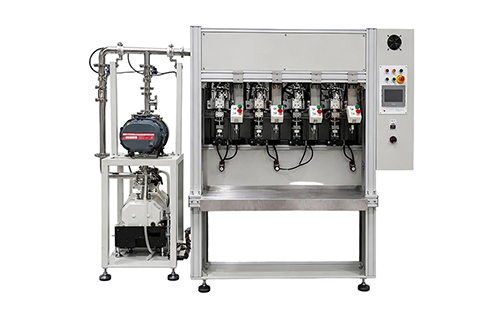
Heat Pipe Filling & Welding Machine for Production
1. What Is a Heat Pipe Filling & Welding Machine?
A Heat Pipe Filling & Welding Machine is industrial equipment that supports two important stages of heat pipe manufacturing: working-fluid filling and tube sealing. Depending on the machine design, it may also support evacuation, positioning, and other process-control functions.
Heat pipes transfer heat through the evaporation and condensation of a working fluid inside a sealed enclosure. Their performance depends on several factors, including the internal wick structure, working fluid, vacuum condition, and manufacturing quality.
During production, manufacturers must introduce the correct amount of working fluid. They must also seal the tube without compromising its integrity. A suitable filling and welding machine helps control these operations and improve production consistency.
For manufacturers serving electronics, power equipment, automotive, and industrial cooling markets, process stability matters. Even small variations in fluid charge or sealing quality can affect product performance and reliability.
A modern machine can help standardize these operations, reduce manual handling, and improve traceability. However, the exact functions depend on the machine configuration and the requirements of each heat pipe design.
2. Why Filling and Welding Matter in Heat Pipe Manufacturing
Heat pipe production requires precise control over several connected processes. Filling and welding deserve particular attention because they directly affect the sealed internal environment.
2.1 Accurate Working-Fluid Filling
A heat pipe requires a suitable working fluid and charge quantity. The correct amount depends on the tube dimensions, wick structure, internal volume, and intended operating conditions.
Too little fluid may limit evaporation and condensation performance. Too much fluid can also create problems under certain operating conditions.
A controlled filling system helps manufacturers deliver repeatable fluid quantities. It can also reduce variation between production batches.
2.2 Reliable Tube Sealing
After the required internal conditions and fluid charge have been established, manufacturers must close the filling port or designated tube section. The welding process must create a durable seal while protecting the surrounding tube.
Poor welding can cause leakage or damage the tube. Excessive heat may also affect nearby components or sensitive structures, depending on the product design.
A properly configured welding process helps maintain consistent sealing quality. Manufacturers should validate welding parameters for each relevant tube material, wall thickness, and joint design.
2.3 Stable Internal Conditions
Heat pipes commonly rely on a controlled internal environment. Non-condensable gases can interfere with heat transfer, so evacuation and degassing procedures may form part of the manufacturing process.
The filling and welding machine should fit the overall process sequence. Some systems combine multiple functions, while others operate alongside dedicated vacuum and degassing equipment.
For related equipment, consider linking to the 🔗 Vapor Chamber Vacuum Filling & Welding Machine or 🔗 Heat Pipe Production Line, where these pages are available on your website.
3. How a Heat Pipe Filling & Welding Machine Works
The exact workflow depends on the heat pipe structure, working fluid, and sealing method. However, most production systems coordinate several essential operations.
3.1 Workpiece Loading and Positioning
Operators load prepared heat pipes into the machine’s fixtures. The fixtures must hold each tube securely and align the filling port with the connection or welding head.
Accurate positioning helps prevent fluid leakage during filling. It also supports repeatable welding conditions.
For high-volume production, manufacturers may prefer fixtures that accommodate multiple workpieces. The correct configuration depends on tube dimensions, product variation, and target output.
3.2 Evacuation and Internal Preparation
Before filling, manufacturers generally remove unwanted gases from the heat pipe. A vacuum system can reduce residual air inside the tube and help establish the required internal conditions.
Some applications also require heating or extended evacuation to remove residual moisture and gases. The appropriate procedure depends on the materials and working fluid.
Research on two-phase thermal devices highlights the importance of removing internal air and non-condensable gases. These gases can obstruct condensation and reduce heat-transfer performance.
PubMed Central (PMC)+1
3.3 Working-Fluid Filling
Once the required conditions are established, the machine introduces the specified working fluid. The filling system should deliver a repeatable charge based on the product’s validated process parameters.
Different heat pipe designs may require different filling methods. Liquid filling, vapor-based charging, and specialized procedures may apply to different fluids and operating temperatures.
For this reason, manufacturers should confirm compatibility between the filling system and the intended working fluid. They should also consider fluid purity, material compatibility, and contamination control.
3.4 Tube Pinching and Welding
After filling, the machine prepares the designated filling section for permanent closure. Depending on the design, this may involve pinching, cutting, welding, or another validated sealing method.
Some systems use crimping followed by welding. Others may use a suitable cold-welding or pinch-off method.
The selected process must create a durable seal without damaging the tube or disturbing its internal condition. Material type and tube-wall thickness influence the appropriate method.
ScienceDirect Topics+1
3.5 Inspection and Process Confirmation
Manufacturers should verify the finished heat pipe after filling and sealing. Inspection may include visual checks, leak testing, charge verification, and thermal performance testing.
A filling and welding machine does not automatically replace these quality-control steps. Instead, it helps create repeatable manufacturing conditions that downstream tests can verify.
4. Key Features to Consider
When comparing a Heat Pipe Filling & Welding Machine, evaluate its process capabilities rather than focusing on the equipment name alone.
4.1 Controlled Filling Accuracy
Filling accuracy is one of the most important selection criteria. The machine should support the charge quantity required by your heat pipe design.
Ask the supplier how the system measures and controls fluid delivery. Also, confirm how operators can check filling consistency during production.
4.2 Vacuum System Compatibility
The vacuum system should match the required process conditions. Consider pump configuration, connection design, monitoring methods, and maintenance access.
Do not judge the entire process by a vacuum reading alone. Residual moisture, material outgassing, and dissolved gases may also affect the internal environment.
A validated process should account for these factors where relevant.
4.3 Suitable Welding Technology
The welding method must match the filling tube material and joint design. Manufacturers may use resistance welding, laser welding, arc welding, or another suitable process.
Each method has different requirements for tooling, energy input, joint preparation, and process monitoring.
Choose equipment that can produce repeatable seals for your actual product range. Sample testing can help confirm whether the proposed configuration meets your requirements.
4.4 Automation and Operator Control
Automation can reduce repetitive manual work and improve process consistency. Depending on the configuration, useful features may include programmable process settings, interlocks, alarms, and production records.
For manufacturers with several product models, adjustable recipes can simplify changeovers. However, each recipe should follow an approved process rather than relying on unverified default settings.
4.5 Fixture Flexibility
Different heat pipes may vary in diameter, length, shape, and filling-port position. Flexible fixtures can help one machine handle multiple products.
Before purchasing, provide the supplier with representative samples or engineering drawings. This step helps confirm whether the proposed fixtures support your actual production needs.
5. Benefits for Heat Pipe Manufacturers
A well-matched filling and welding system can improve several aspects of production.
- More consistent fluid charging: Controlled filling helps reduce variation between units.
- Repeatable sealing: Suitable tooling and welding parameters support consistent closure quality.
- Reduced manual handling: Integrated operations can reduce the need to transfer workpieces between separate stations.
- Improved process traceability: Compatible controls can record key settings and production results.
- Better production planning: Stable cycle times can help manufacturers organize labor and output.
- Support for product expansion: Appropriate fixtures and adjustable settings can simplify the introduction of new models.
These benefits depend on the machine configuration, product design, and production management. Equipment alone cannot guarantee thermal performance or a defect-free production process.
Manufacturers should evaluate the complete workflow, including cleaning, evacuation, filling, sealing, inspection, and final testing.
6. Applications Across Thermal Management Industries
Heat pipes support passive heat transfer in a wide range of thermal management systems. A suitable filling and welding process helps manufacturers produce components for different applications.
6.1 Consumer Electronics and Computing
Heat pipes transfer heat away from processors and other heat-generating components. Manufacturers must maintain consistent internal conditions to support reliable cooling assemblies.
6.2 Power Electronics
Power converters, control equipment, and electrical systems may use heat pipes to manage concentrated heat loads. Consistent filling and sealing help support product quality.
6.3 Automotive and Transportation
Automotive electronics and selected thermal management assemblies can use heat pipes where their operating conditions and mechanical requirements are suitable.
6.4 Industrial Cooling and Energy Systems
Heat pipes can support heat recovery and temperature control in suitable industrial equipment. Some high-temperature applications require specialized working fluids and manufacturing procedures.
The intended application influences the required tube materials, working fluid, sealing technology, and inspection standards. Therefore, equipment selection should start with the finished product requirements.
7. How to Choose the Right Heat Pipe Filling & Welding Machine
A structured evaluation helps manufacturers avoid purchasing equipment that does not fit their production needs.
7.1 Define Your Product Range
Start by documenting the heat pipes you plan to manufacture. Include tube dimensions, material, filling-port design, working fluid, and expected production volume.
Also identify whether your products use conventional copper-water construction or specialized high-temperature designs. These products may require significantly different process arrangements.
7.2 Confirm Filling and Sealing Requirements
Specify the target fluid charge and the acceptable variation. Explain the required internal condition and the planned sealing method.
Ask the supplier to describe which operations the machine performs directly. Clarify whether evacuation, degassing, fluid preparation, and inspection require separate equipment.
This prevents misunderstandings about the scope of an integrated system.
7.3 Evaluate Production Capacity
Consider expected output per shift, changeover frequency, operator requirements, and planned future growth.
A multi-station configuration may support higher output when the process and workpiece handling allow parallel operations. However, actual capacity depends on cycle time, loading method, inspection requirements, and equipment availability.
Request a demonstration or sample-production trial when possible.
7.4 Check Safety and Maintenance
Working fluids differ in their chemical and physical properties. Some applications involve elevated temperatures, reactive materials, or specialized handling requirements.
Confirm that the equipment includes appropriate safeguards for the intended process. Review maintenance access, consumable requirements, spare parts, and operator training.
7.5 Request Product-Specific Validation
A supplier should assess representative workpieces before final equipment approval. Ask for evidence that the proposed system can meet the agreed filling, sealing, and quality requirements.
Useful acceptance criteria may include:
- Filling repeatability.
- Seal appearance and consistency.
- Leak-test results.
- Cycle time under defined operating conditions.
- Repeatability across multiple workpieces.
- Ease of changeover between approved product models.
These checks provide a more meaningful basis for purchasing than general performance claims.
8. Integration with a Heat Pipe Production Line
A Heat Pipe Filling & Welding Machine usually operates as part of a broader manufacturing process.
A typical production route may include:
- Tube cutting and preparation.
- Wick structure installation or formation.
- Component cleaning.
- End-cap assembly and joining, where required.
- Initial leak checks and preparation.
- Evacuation and working-fluid charging.
- Filling-port closure and sealing.
- Final leak inspection.
- Thermal performance testing.
- Final inspection and packaging.
The exact order varies with product design and manufacturing method. Some processes combine stages, while others use separate vacuum, degassing, filling, and welding stations.
For example, manufacturers may pair a filling and welding system with a 🔗 Heat Pipe Multi-station Dry-out Tester to support process verification. They may also consider a 🔗 Heat Pipe Production Line when planning broader automation.
Other useful internal-link opportunities include:
🔗 Heat Pipe Powder Filling Machine
🔗 Heat Pipe Thermal Performance Tester
🔗 Heat Pipe Leak Testing Equipment
🔗 Vapor Chamber Vacuum Filling & Welding Machine
Use these as internal links only where matching pages exist on Linkthermal. Each link should lead to a relevant product or technical page rather than an unrelated category.
9. Quality Control and Common Production Issues
Quality control should cover both the manufacturing process and the finished heat pipe.
Production issue | Possible cause | Recommended action |
Inconsistent thermal performance | Variable fluid charge or internal contamination | Review filling control, cleaning, and process records |
Leakage near the filling port | Incorrect positioning or unsuitable welding parameters | Check fixtures, joint preparation, and weld settings |
Residual non-condensable gases | Inadequate evacuation or gas contamination | Review evacuation, fluid purity, and degassing procedures |
Tube deformation | Excessive clamping force or welding heat | Optimize fixtures and validate process parameters |
Frequent production stoppages | Poor setup, maintenance, or inconsistent loading | Review operator procedures and preventive maintenance |
These are possible causes, not definitive diagnoses. Manufacturers should investigate each failure using inspection results and process records.
9.1 Separate Leak Testing from Thermal Testing
Leak testing checks whether the sealed enclosure meets the specified leakage requirement. Thermal testing evaluates heat-transfer behavior under defined conditions.
A heat pipe may pass one test but fail another. Therefore, manufacturers should select test methods that address the actual risks of their products.
9.2 Maintain Process Records
Record relevant parameters such as filling settings, vacuum conditions, welding parameters, and inspection results where the equipment supports them.
Consistent records help engineers identify trends and compare production batches. They also support troubleshooting when a customer reports a field issue.
For background on heat pipe manufacturing and inspection, see the technical overview from IntechOpen: Gravity in Heat Pipe Technology.
IntechOpen
10. Why Consider Linkthermal?
When selecting heat pipe manufacturing equipment, buyers need more than a machine that performs a single operation. They need a configuration that matches their product design, target output, and quality requirements.
Linkthermal can use this section to explain its relevant equipment capabilities and engineering support. Keep the final published copy aligned with the company’s actual offerings and verified specifications.
When evaluating a supplier, consider these questions:
- Can the supplier assess your heat pipe samples and manufacturing process?
- Can the equipment accommodate your required tube dimensions and sealing method?
- Does the proposed configuration include filling, evacuation, and welding, or only selected functions?
- Can the supplier support installation, commissioning, training, and maintenance?
- Can the supplier provide suitable process validation and acceptance testing?
A clear technical discussion helps buyers determine whether the equipment suits their current production needs. It also helps establish a practical foundation for future automation.
11. Frequently Asked Questions
11.1 What does a Heat Pipe Filling & Welding Machine do?
It supports working-fluid charging and the sealing of heat pipes. Depending on its configuration, it may also coordinate evacuation, workpiece positioning, and process monitoring.
11.2 Why does filling accuracy matter?
The working-fluid charge affects heat pipe operation. An unsuitable charge may reduce performance or create operating problems. Manufacturers should establish the correct charge for each product design and verify its repeatability.
11.3 Does the machine include a vacuum pump?
Not necessarily. Some systems integrate vacuum equipment, while others connect to a separate vacuum station. Buyers should confirm the exact scope before purchasing.
11.4 Which welding method is best for heat pipe sealing?
There is no universal answer. The appropriate method depends on tube material, wall thickness, joint design, and production requirements. Sample testing helps determine a suitable process.
11.5 Can one machine handle different heat pipe sizes?
It may be possible when the machine supports compatible fixtures and adjustable process settings. Buyers should confirm the supported size range and changeover requirements with the supplier.
11.6 Is a filling and welding machine enough to ensure heat pipe quality?
No. It supports important manufacturing operations, but overall quality also depends on material cleanliness, internal preparation, fluid compatibility, sealing integrity, and final inspection.
11.7 What other equipment may be needed?
Depending on the production process, manufacturers may need cleaning equipment, vacuum or degassing systems, powder filling equipment, dry-out testers, leak-testing equipment, and thermal performance testers.
11.8 How can manufacturers improve production consistency?
Use validated process parameters, maintain the equipment, train operators, control fluid quality, and review inspection data. Automated monitoring can also help identify deviations before they affect larger production batches.
12. Conclusion
A Heat Pipe Filling & Welding Machine plays an important role in producing reliable thermal management components. It helps manufacturers control working-fluid charging and create consistent sealed joints.
The right configuration depends on tube dimensions, working fluid, sealing technology, production volume, and quality requirements. Manufacturers should also consider how the machine integrates with evacuation, degassing, leak testing, and thermal performance testing.
Before purchasing, define your product specifications and request product-specific validation. This approach helps reduce process uncertainty and supports a more consistent manufacturing workflow.
For manufacturers planning to upgrade their production capabilities, Linkthermal can present the relevant equipment options and technical information needed to evaluate a suitable solution.