
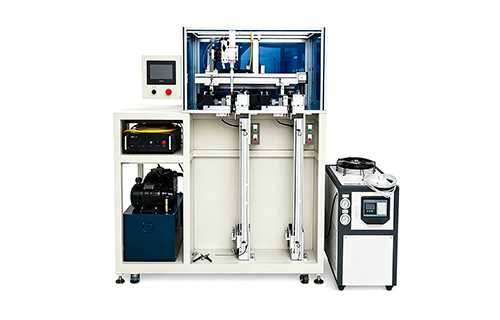
Vapor Chamber Vacuum Filling & Welding Machine Guide
Introduction
Modern electronics need reliable thermal management to maintain performance and operating stability. Therefore, manufacturers increasingly use vapor chambers to spread heat across compact surfaces.
However, a vapor chamber requires more than a copper enclosure and an internal wick structure. Manufacturers must also control evacuation, working fluid charging, and final sealing.
A Vapor Chamber Vacuum Filling & Welding Machine combines essential operations for preparing and sealing vapor chambers. Depending on its configuration, the system can evacuate internal air, introduce a measured amount of working fluid, and close the filling port.
These operations directly influence chamber integrity and thermal performance. For example, residual non-condensable gases can interfere with vapor movement and reduce heat transfer efficiency.
Meanwhile, inaccurate fluid charging can affect startup behavior and thermal resistance. An unreliable final weld can also cause leakage during service.
Therefore, manufacturers need stable process control and suitable inspection procedures. Automation can improve repeatability while reducing manual handling during critical production stages.
linkthermal focuses on thermal management manufacturing equipment and production solutions. Its website, https://linkthermal.com/, provides a starting point for exploring vapor chamber and heat pipe manufacturing equipment.
This guide explains vacuum filling, laser welding, equipment configuration, quality control, and machine selection. It also outlines how manufacturers can integrate these processes into a complete production line.
1. What Is a Vapor Chamber Vacuum Filling & Welding Machine?
A Vapor Chamber Vacuum Filling & Welding Machine combines vacuum processing, working fluid charging, and sealing operations. Depending on the design, one system can manage several steps within a coordinated production cycle.
First, the machine removes air and non-condensable gases from the chamber. Next, its filling unit introduces a controlled quantity of working fluid. Finally, a suitable sealing mechanism closes the filling port.
Some configurations use laser welding. Others use resistance welding, mechanical crimping, or alternative sealing technologies. The correct method depends on the chamber design and material.
A typical system may include:
Vacuum pumps and vacuum control valves
A working fluid storage and delivery unit
Precision metering equipment
Product positioning fixtures
A filling interface
A pre-sealing mechanism
A laser or resistance welding unit
A programmable logic controller (PLC)
A human-machine interface (HMI)
Safety protection and process monitoring
Moreover, some machines record vacuum levels, filling quantities, and welding parameters. This information helps manufacturers track production quality and investigate process deviations.
For example, an integrated machine can reduce transfers between separate vacuum, filling, and sealing stations. However, actual cycle time and accuracy depend on the selected configuration and product requirements. thermalmachinery.com
2. Why Vacuum Filling and Welding Matter
A vapor chamber transfers heat through evaporation and condensation inside a sealed enclosure. Its internal wick returns condensed liquid toward the heat source.
Therefore, manufacturers must maintain suitable internal conditions throughout the product’s service life.
2.1 Removing Non-Condensable Gases
Residual air and other non-condensable gases can interfere with vapor movement. They may also reduce the effective heat transfer area.
Vacuum processing helps remove these unwanted gases before final sealing. Consequently, effective degassing supports stable thermal performance.
2.2 Controlling Working Fluid Quantity
Every vapor chamber design requires a suitable working fluid charge.
Too little fluid may restrict liquid return and impair heat transfer. Conversely, excessive fluid can reduce available vapor space and affect operating behavior.
Therefore, manufacturers should determine the target charge through product design and process validation.
2.3 Maintaining Hermetic Sealing
The finished chamber must retain its working fluid and internal conditions.
Even a small leak can compromise reliability. Therefore, manufacturers should validate the filling-port seal and inspect finished products using suitable leak testing.
2.4 Supporting Production Consistency
Manual filling can introduce variation between batches. Automated metering and programmable process settings help reduce that variation.
Moreover, integrated processing can reduce handling between stations. This arrangement also simplifies process coordination.
3. How the Machine Works
The machine follows a controlled sequence that connects evacuation, fluid charging, and sealing.
First, operators load the prepared vapor chamber into a dedicated fixture. The fixture aligns the filling port with the processing head.
Next, the machine establishes a suitable connection around the port. Its vacuum system then removes air and residual gases according to the validated process recipe.
After reaching the required vacuum condition, the filling unit delivers the specified working fluid quantity. Depending on the design, the system may use a metering pump, flow measurement, or weighing feedback.
The machine then closes the filling port temporarily or prepares it for immediate sealing. This step helps limit air ingress and fluid loss.
Finally, the sealing unit completes the closure. The machine may use laser welding, resistance welding, or another suitable method.
After sealing, operators or automated inspection equipment verify the product against defined acceptance criteria.
The exact sequence varies by equipment design. Some systems use a dedicated filling tube, while others use specialized port arrangements.
Consequently, buyers should confirm compatibility with their vapor chamber construction before selecting equipment.
4. Main Components of the Equipment
4.1 Vacuum System
The vacuum system removes air and non-condensable gases from the chamber.
Depending on the required vacuum level, the configuration may combine roughing pumps, high-vacuum pumps, valves, and pressure sensors.
Furthermore, vacuum stability matters as much as pump capacity. Manufacturers should select the system according to internal volume, leakage characteristics, and cycle time.
4.2 Precision Filling Unit
The filling unit delivers the specified working fluid quantity.
Depending on the design, it may use a metering pump, flowmeter, weighing system, or combined feedback controls.
Moreover, the fluid path should support cleanliness and compatibility with the selected working fluid.
4.3 Positioning Fixture
The fixture holds the vapor chamber and aligns the filling port.
Accurate positioning helps prevent connection problems and inconsistent sealing.
Additionally, quick-change fixtures can simplify production changes between compatible product sizes.
4.4 Welding and Sealing Unit
The sealing unit closes the filling port after fluid charging.
Laser welding offers localized energy delivery and programmable motion. Resistance welding provides another option for suitable joint designs.
However, manufacturers must validate each method against material thickness, port geometry, and sealing requirements.
4.5 Control and Monitoring System
The PLC coordinates the operating sequence. Meanwhile, the HMI allows operators to select recipes and monitor machine status.
Advanced configurations may also record vacuum levels, filling quantities, and welding parameters.
Therefore, manufacturers can use process records to support traceability and troubleshooting.
5. The Vacuum Filling and Welding Process
A reliable production process requires consistent preparation and clear quality checks.
Step 1: Prepare the Vapor Chamber
First, inspect the chamber body, wick structure, and filling port.
Remove contamination according to the validated cleaning procedure. Additionally, verify that the product matches the selected fixture.
Step 2: Load and Position the Product
Next, place the chamber into the machine.
The fixture aligns the filling port with the vacuum and filling interface. Correct alignment helps establish a reliable connection.
Step 3: Evacuate the Chamber
The vacuum system removes internal gases.
Operators should monitor the pressure profile and confirm that the chamber reaches the specified process condition.
Furthermore, abnormal evacuation behavior may indicate leakage, contamination, or connection problems.
Step 4: Introduce the Working Fluid
The filling unit delivers the required fluid quantity.
The target depends on chamber volume, wick characteristics, and thermal design.
Therefore, manufacturers should establish filling recipes through engineering trials and quality validation.
Step 5: Close the Filling Port
After charging, the machine prepares the port for final sealing.
A suitable pre-sealing operation can help limit fluid loss and air ingress before the final weld.
However, the precise method depends on the machine architecture.
Step 6: Complete Final Welding
The sealing unit closes the filling port.
The process must create a continuous, reliable joint without damaging nearby thin-wall structures.
Consequently, manufacturers should validate welding parameters and fixture alignment.
Step 7: Inspect the Finished Product
Finally, the manufacturer checks the seal and verifies product quality.
Suitable methods may include visual inspection, pressure-based testing, helium leak testing, and thermal performance evaluation.
The acceptance criteria should match the product specification and customer requirements.
6. Key Features and Advantages
A well-configured Vapor Chamber Vacuum Filling & Welding Machine can improve several aspects of manufacturing.
Integrated Processing
Combining vacuum treatment, filling, and sealing can reduce transfers between separate stations.
As a result, manufacturers can simplify material handling and coordinate process timing.
Controlled Fluid Charging
Automated metering helps maintain a repeatable working fluid quantity.
Moreover, recipe management can support different product specifications.
Improved Process Traceability
Selected systems record important operating parameters.
Therefore, production teams can review process history when investigating defects.
Reduced Manual Handling
Automation reduces repetitive operator involvement during critical operations.
Consequently, workers can focus on loading, inspection, and process supervision.
Flexible Product Changeover
Compatible fixtures and programmable recipes can support different chamber designs.
However, manufacturers should confirm the actual changeover requirements and tooling costs.
Production Line Integration
The machine can connect with upstream assembly and downstream inspection equipment.
Furthermore, suitable communication interfaces can support factory data collection.
7. Common Manufacturing Challenges
Inconsistent Vacuum Performance
Unstable vacuum conditions can affect degassing results.
Therefore, manufacturers should inspect seals, connections, valves, and pump performance regularly.
Incorrect Fluid Quantity
An inaccurate charge can affect chamber operation.
Moreover, changes in internal volume or wick structure may require a different filling recipe.
Filling Port Contamination
Residues around the port can interfere with sealing.
Consequently, manufacturers should maintain consistent cleaning and handling procedures.
Welding Defects
Incorrect energy input, poor alignment, or unsuitable joint geometry can produce defects.
Therefore, manufacturers should validate the sealing process with representative samples.
Thin-Wall Deformation
Vapor chambers often use thin metal enclosures.
Excessive clamping force or heat can cause deformation. Consequently, suitable fixtures and carefully controlled process settings remain essential.
Working Fluid Safety
Different working fluids have different chemical and safety properties.
Manufacturers must confirm fluid compatibility, ventilation requirements, and applicable fire protection measures before operation.
8. Vacuum Filling and Welding Quality Control
Quality control should cover the entire process, not just the final weld.
First, manufacturers should verify vacuum performance. Next, they should monitor filling quantity and sealing parameters.
Afterward, appropriate inspection methods can identify defects before shipment.
Quality Check | Purpose |
Vacuum profile monitoring | Confirms the evacuation process follows the recipe |
Filling quantity verification | Checks working fluid dosage |
Visual weld inspection | Identifies visible surface defects |
Leak testing | Evaluates sealing integrity |
Dimensional inspection | Checks flatness and product dimensions |
Thermal performance testing | Evaluates heat transfer behavior |
However, no single inspection method can confirm every aspect of product quality.
For example, visual inspection cannot reliably identify every microscopic leak. Therefore, manufacturers should select tests according to product risk and customer specifications.
Research on ultra-thin vapor chambers also highlights the importance of reliable sealing and validation.
9. Applications in Vapor Chamber Manufacturing
Consumer Electronics
Smartphones, laptops, and gaming devices require compact thermal solutions.
Therefore, manufacturers use vapor chambers in suitable designs to spread heat from concentrated sources.
AI Servers and Data Centers
High-performance computing systems generate substantial heat.
Consequently, thermal engineers evaluate vapor chambers and related cooling components for selected server architectures.
Graphics Processing Units
GPUs create concentrated heat loads during intensive computing.
Vapor chambers can help spread heat across a larger cooling area when the design suits the application.
Automotive Electronics
Electric vehicles use power electronics and control systems that require reliable thermal management.
Manufacturers may use vapor chambers in selected applications, depending on operating conditions and product design.
Telecommunications Equipment
Networking and communication hardware often operates continuously.
Therefore, manufacturers need thermal components with repeatable quality and reliable sealing.
Across these applications, vacuum filling and sealing equipment helps manufacturers maintain consistent production processes.
10. Integration With a Vapor Chamber Production Line
The vacuum filling and welding station forms part of a broader manufacturing workflow.
A typical line may include:
Production Stage | Recommended Internal Link |
Copper plate forming | |
Wick material preparation | |
Wick sintering | |
Plate assembly and forming | |
Enclosure joining | |
Vacuum processing and fluid charging | |
Final port closure | |
Final inspection | |
Complete manufacturing workflow |
The exact sequence depends on the product design and sealing method.
For example, some processes weld the chamber perimeter before vacuum filling. Then, a separate operation closes the filling port.
Other designs may combine selected vacuum and sealing operations differently.
Therefore, manufacturers should design equipment integration around the actual product process rather than a generic sequence.
Complete Production Guide –
+1
11. How to Choose the Right Machine
Before requesting a quotation, define the product and production requirements.
Product dimensions: Specify length, width, thickness, and filling-port geometry.
Working fluid: Identify the fluid and confirm material compatibility.
Vacuum requirement: Define the target vacuum condition and acceptable process time.
Filling accuracy: Establish the required fluid quantity and allowable variation.
Sealing method: Confirm whether laser welding, resistance welding, or another process suits the design.
Production capacity: Provide the target output per hour or shift.
Automation level: Determine loading, unloading, and inspection requirements.
Quality requirements: Specify leak testing, dimensional checks, and thermal performance tests.
Traceability: Decide whether the system must record process data or connect to factory software.
Maintenance and support: Confirm spare parts, training, commissioning, and service arrangements.
Furthermore, provide product drawings and representative samples when possible.
These details help the supplier evaluate the required fixtures, vacuum system, filling technology, and sealing method.
12. Operating Costs and Maintenance
The purchase price represents only one part of the total ownership cost.
Manufacturers should also consider electricity, vacuum pump maintenance, sealing consumables, spare parts, and production downtime.
Vacuum Pump Maintenance
Follow the pump manufacturer’s service schedule.
Additionally, inspect filters, seals, and connections for wear or contamination.
Filling System Maintenance
Keep fluid paths clean and check metering performance regularly.
Furthermore, verify the filling quantity against a suitable reference method.
Welding Unit Maintenance
Inspect welding optics, electrodes, or other process components according to the selected technology.
Consequently, routine checks can help prevent avoidable process variation.
Fixture Inspection
Check alignment surfaces, clamps, and port connections.
Worn fixtures can affect positioning and sealing quality.
Safety System Inspection
Verify interlocks, emergency stops, ventilation, and fluid handling controls.
For flammable working fluids, confirm that the equipment and facility meet the applicable hazardous-area requirements.
13. Why Consider linkthermal?
Choosing thermal manufacturing equipment requires attention to the complete production process.
linkthermal focuses on thermal management manufacturing equipment and related production solutions. Its website provides information for manufacturers exploring vapor chamber and heat pipe production technologies.
When evaluating a vacuum filling and welding system, buyers should confirm the available configuration and technical specifications.
For example, ask about vacuum performance, filling methods, welding options, fixture design, and inspection interfaces.
Additionally, discuss the target product dimensions and required production capacity.
These details help determine whether the equipment fits the intended manufacturing process.
Visit the official website at https://linkthermal.com/ to explore the company’s equipment portfolio.
Before publishing specific performance claims, confirm them against the actual machine configuration and supporting technical documentation.
14. Frequently Asked Questions
What does a vapor chamber vacuum filling and welding machine do?
It removes internal gases, introduces a controlled amount of working fluid, and closes the filling port.
Depending on its configuration, it can combine these operations within one coordinated production cycle.
Why does a vapor chamber need vacuum filling?
Vacuum processing helps remove air and non-condensable gases.
Meanwhile, controlled fluid charging supports the intended phase-change heat transfer process.
Which working fluids can the machine handle?
The compatible fluid depends on the machine’s materials, seals, delivery system, and safety design.
Manufacturers should confirm compatibility before selecting or changing fluids.
How does the machine control filling quantity?
Depending on its configuration, the system may use a metering pump, flowmeter, weighing feedback, or combined controls.
The manufacturer should validate the selected method against the product’s filling tolerance.
Which sealing methods can the machine use?
Depending on the design, the machine may use laser welding, resistance welding, or another suitable sealing process.
The correct method depends on the filling port, material, and product requirements.
Does vacuum filling guarantee good thermal performance?
No. Vacuum filling supports internal cleanliness and fluid control, but other factors also matter.
Wick structure, chamber geometry, fluid quantity, and sealing integrity all affect performance.
How do manufacturers test for leaks?
Manufacturers may use pressure-based methods or helium leak testing.
The appropriate method depends on the product specification and required detection sensitivity.
Can one machine handle different vapor chamber sizes?
Potentially, yes. Compatible fixtures and programmable recipes can support multiple product designs.
However, manufacturers should confirm the working range and changeover requirements.
Can the machine connect to an automatic production line?
Yes, suitable systems can connect with upstream assembly and downstream inspection equipment.
However, integration depends on machine interfaces, material handling, and factory requirements.
What information should I provide when requesting a quotation?
Provide product drawings, dimensions, working fluid, filling quantity, vacuum requirements, sealing method, and target output.
Additionally, specify quality standards and traceability requirements.
15. Conclusion
A Vapor Chamber Vacuum Filling & Welding Machine supports three critical manufacturing functions: evacuation, working fluid charging, and final sealing.
When manufacturers coordinate these operations carefully, they can improve process consistency and reduce unnecessary product handling.
However, reliable performance requires suitable vacuum control, accurate filling, compatible materials, and validated sealing parameters.
Quality inspection also matters. Leak testing and thermal performance evaluation help manufacturers verify the finished product.
For the best equipment selection, start with the chamber design and production target. Then evaluate vacuum performance, filling accuracy, sealing technology, automation, and maintenance requirements.
linkthermal focuses on thermal management manufacturing equipment and related production solutions.
Visit https://linkthermal.com/ to explore relevant equipment and confirm the available configurations for your application.