
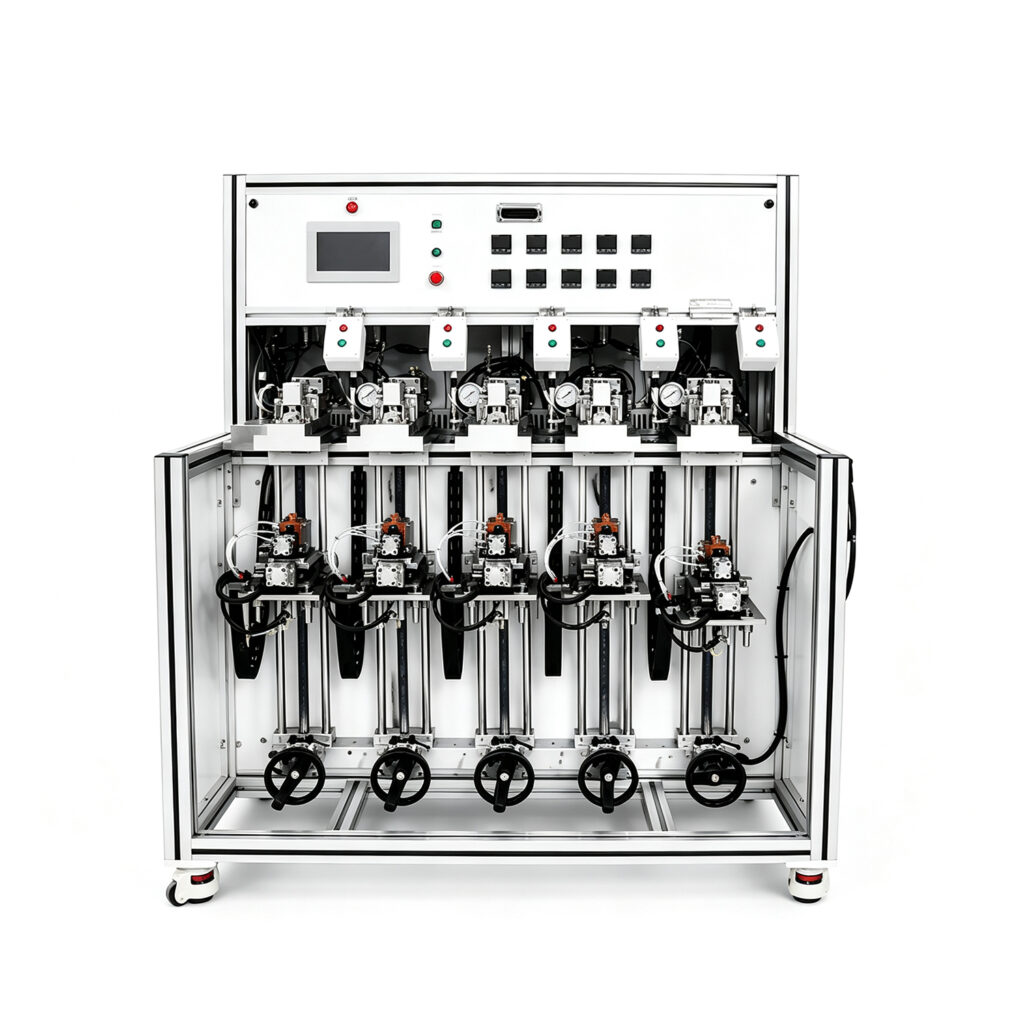
Heat Pipe Necking Machine for Precision Tube Forming
1. What Is a Heat Pipe Necking Machine?
A Heat Pipe Necking Machine is specialized equipment that reduces the diameter of a selected section of a heat pipe tube. It creates a narrower end or transition area while maintaining the required tube shape and dimensions.
Manufacturers use necking to prepare heat pipe tubes for later operations. These operations may include sealing, filling, welding, or connection with other components. The exact purpose depends on the heat pipe design.
Heat pipes transfer thermal energy through the evaporation and condensation of an internal working fluid. Their performance depends on the sealed enclosure, wick structure, working fluid, and internal operating conditions.
During manufacturing, tube dimensions must meet the requirements of the finished product. A necking machine helps control local tube deformation and supports repeatable component preparation.
For manufacturers producing copper heat pipes, compact cooling assemblies, or customized thermal components, controlled necking can improve production consistency. It also reduces dependence on manual tube forming.
However, necking parameters must match the tube material, wall thickness, diameter, and product geometry. Excessive deformation may damage the tube or affect its internal structure.
2. Why Necking Matters in Heat Pipe Manufacturing
Necking is more than a simple tube-reduction operation. It prepares the heat pipe for subsequent manufacturing steps and helps maintain dimensional accuracy.
2.1 Preparing Tube Ends for Sealing
Some heat pipe designs require a reduced tube section near the filling end. This section can provide a suitable area for later pinching, welding, or sealing.
The necking process creates the required geometry before those operations. Consistent dimensions can make downstream positioning and joining easier.
2.2 Supporting Compact Product Designs
Thermal management products often have limited installation space. Engineers may design heat pipes with different diameters along their length.
A necked section can help the tube fit a specific assembly or connection. It can also support transitions between different component sizes.
2.3 Improving Dimensional Consistency
Manual tube forming can produce variations between workpieces. A dedicated machine helps standardize the forming process.
Manufacturers can define suitable tooling and process parameters for each product model. This approach supports repeatable tube dimensions and reduces unnecessary adjustments.
2.4 Protecting Tube Integrity
Heat pipes use thin-walled metal tubes in many applications. The necking process must reduce the diameter without causing cracks, wrinkles, excessive thinning, or unwanted deformation.
Manufacturers should validate the forming process using the actual tube material and dimensions. They should also inspect the finished section before moving to later production stages.
3. How a Heat Pipe Necking Machine Works
The operating sequence depends on the machine structure and the required tube geometry. A typical process includes the following steps.
3.1 Tube Loading and Positioning
The operator places the prepared tube into the machine fixture. The fixture holds the workpiece and positions the target area under the forming mechanism.
Accurate positioning determines where the necked section begins and ends. It also helps maintain consistent forming length across different workpieces.
3.2 Clamping and Alignment
The machine secures the tube before forming begins. Proper clamping prevents unwanted movement during the necking operation.
The fixture should support the tube without creating excessive surface pressure. Alignment also matters because an offset workpiece may produce an uneven reduction.
3.3 Diameter Reduction
The forming mechanism applies controlled force to the selected tube section. Depending on the machine design, it may use dies, rollers, or another forming structure.
The tooling gradually reduces the outside diameter to the required dimension. The process should avoid sudden deformation that could damage the tube wall.
3.4 Forming Release and Unloading
After reaching the target geometry, the machine releases the workpiece. The operator or automatic handling system then removes the formed tube.
The machine may support manual loading, semi-automatic operation, or automated production. The appropriate configuration depends on output requirements and product variation.
3.5 Dimensional Inspection
Manufacturers should inspect the necked section after forming. Typical checks include:
- Reduced outside diameter.
- Necking length.
- Transition shape.
- Concentricity and alignment.
- Surface condition.
- Evidence of cracks, wrinkles, or excessive thinning.
Inspection criteria should come from the product drawing and approved process specifications.
4. Common Heat Pipe Necking Methods
Different forming methods suit different tube materials and product geometries. Buyers should understand the available methods before selecting equipment.
4.1 Die-Based Necking
Die-based necking uses shaped tooling to reduce the tube diameter. The tube enters a forming die that creates the required reduced section.
This method can support repeatable geometry when the tooling matches the tube dimensions. It is suitable for production processes that use consistent product designs.
Tool design, material properties, and forming force all influence the final result.
4.2 Roller Necking
Roller necking uses rotating or moving rollers to form the tube. The rollers gradually reduce the diameter along the selected section.
This approach may suit certain tube geometries and production requirements. However, the tooling arrangement must provide stable support and consistent deformation.
4.3 Custom Forming Solutions
Some heat pipe designs require special transitions, short necking lengths, or non-standard end shapes. These applications may need customized tooling or forming arrangements.
Manufacturers should provide drawings and representative samples before equipment selection. This allows the supplier to evaluate tooling compatibility and process feasibility.
5. Key Features to Consider
When comparing a Heat Pipe Necking Machine, focus on the machine’s ability to meet your actual product requirements.
5.1 Supported Tube Dimensions
Check the supported tube diameter, wall thickness, length, and material range. These factors determine whether the machine can handle your current products.
If you manufacture several heat pipe models, ask about tooling changes and setup time. Do not assume one fixture can support every tube size.
5.2 Necking Accuracy
The machine should produce the required reduced diameter and forming length. Ask the supplier how the system controls the forming position and final dimensions.
Also confirm the inspection method used during sample testing. Dimensional results should match your engineering drawings.
5.3 Adjustable Forming Parameters
Different tube materials may require different forming conditions. Adjustable settings can help operators adapt the machine to approved product specifications.
However, each setting should follow a validated process. Uncontrolled adjustments can increase dimensional variation and material damage.
5.4 Tooling and Fixture Design
Tooling has a direct influence on forming quality. It should match the tube material, dimensions, and required transition shape.
Consider the following points:
- Tooling replacement and adjustment.
- Workpiece positioning accuracy.
- Fixture stability.
- Tool wear and maintenance.
- Availability of customized dies.
- Changeover time between product models.
5.5 Automation and Production Control
Automation can improve consistency and reduce repetitive operator work. Depending on the configuration, useful features may include automatic feeding, positioning, forming control, and unloading.
For manufacturers with high output requirements, automated handling may reduce manual intervention. For smaller production batches, a simpler semi-automatic system may offer better flexibility.
6. Benefits for Heat Pipe Manufacturers
A suitable necking machine can improve tube preparation and support a more stable production process.
6.1 Consistent Tube Geometry
Controlled forming helps manufacturers produce repeatable necking dimensions. Consistent geometry makes it easier to maintain downstream assembly requirements.
6.2 Reduced Manual Forming
Manual forming can require considerable operator skill. A dedicated machine standardizes the forming action and reduces repetitive manual work.
6.3 Improved Production Efficiency
A suitable machine can shorten the time required to form each tube. Automated positioning and unloading may further improve production flow.
Actual output depends on the tube dimensions, forming method, loading arrangement, and inspection requirements.
6.4 Better Compatibility with Downstream Processes
Consistent necked sections can support later operations such as pinching, filling, and welding. This helps manufacturers coordinate different production stages.
For related equipment, consider adding internal links to:
🔗 Heat Pipe Filling & Welding Machine
🔗 Heat Pipe Multi-station Dry-out Tester
🔗 Heat Pipe Powder Filling Machine
🔗 Heat Pipe Thermal Performance Tester
Use each anchor only when the corresponding page is available on Linkthermal.
7. Applications in Thermal Management
Heat pipes appear in many thermal management products. Their tube geometry varies according to the installation space, heat load, and assembly design.
7.1 Computer and Electronics Cooling
Heat pipes help transfer heat away from processors, graphics components, and other electronic devices. Some assemblies use different tube diameters or special end geometries.
A necking machine can prepare selected tube sections when the product design requires diameter reduction.
7.2 Industrial Heat Dissipation
Industrial control systems and power electronics may use heat pipes in cooling assemblies. Manufacturers must prepare tubes that meet the mechanical and dimensional requirements of each design.
7.3 Automotive Electronics
Automotive electronic systems can generate concentrated heat. Heat pipes may support thermal management in applications where their operating conditions and mechanical requirements are suitable.
7.4 Customized Cooling Modules
Specialized cooling products may require heat pipes with unique shapes and connection dimensions. Custom necking tooling can support these product requirements.
The actual application depends on the finished assembly. Necking itself does not determine the thermal performance of the heat pipe.
8. How to Choose the Right Heat Pipe Necking Machine
Selecting suitable equipment starts with a clear understanding of your products and production targets.
8.1 Define Your Tube Specifications
Prepare the technical information before contacting a supplier. Include:
- Tube material, such as copper or another specified metal.
- Original outside diameter.
- Tube wall thickness.
- Required necked diameter.
- Necking length and transition shape.
- Overall tube length.
- Annual or daily production volume.
Engineering drawings help suppliers assess the required tooling and machine structure.
8.2 Confirm the Forming Method
Ask the supplier which forming method suits your tube design. Die-based and roller-based systems have different tooling requirements.
The supplier should explain the advantages and limitations of the proposed method. Sample forming can help confirm whether the process meets your requirements.
8.3 Evaluate Finished Product Quality
Do not evaluate the machine only by its advertised forming speed. Finished tube quality matters more.
Check the necked diameter, length, alignment, surface condition, and material integrity. For critical applications, consider additional inspection methods based on your quality standards.
8.4 Consider Production Capacity
Estimate your expected output and available operator resources. A semi-automatic machine may suit flexible, small-batch production.
A more automated system may suit manufacturers with stable product specifications and higher output requirements. Compare actual cycle times under realistic production conditions.
8.5 Review Maintenance and Technical Support
Ask about tooling life, replacement parts, maintenance intervals, and operator training. Also confirm whether the supplier can provide technical support during installation and commissioning.
A machine that is easy to maintain can help reduce unexpected production interruptions.
9. Integration with a Heat Pipe Production Line
A Heat Pipe Necking Machine normally performs one operation within a larger manufacturing process. Its position depends on the heat pipe structure and the factory’s production method.
A representative manufacturing workflow may include:
- Copper tube cutting and preparation.
- Tube cleaning and surface treatment.
- Wick structure installation or formation.
- Tube end forming and necking, where required.
- End closure or component joining.
- Evacuation and working-fluid filling.
- Pinching and welding of the filling section.
- Leak inspection.
- Dry-out or other process verification, where required.
- Thermal performance testing.
- Final inspection and packaging.
Not every heat pipe uses the same sequence. Some designs require necking before filling, while others use different end-forming arrangements.
Manufacturers should confirm the correct process order with their engineering team. They should also coordinate the necking machine with downstream fixtures and handling systems.
For a broader equipment configuration, consider linking to the 🔗 Heat Pipe Production Line page. You can also connect this article to the 🔗 Heat Pipe Filling & Welding Machine and 🔗 Heat Pipe Multi-station Dry-out Tester pages.
10. Common Necking Problems and Solutions
Tube forming problems can affect both appearance and downstream assembly. The following table summarizes common issues and possible corrective actions.
Problem | Possible cause | Recommended action |
Uneven necking | Incorrect alignment or unstable clamping | Check fixture positioning and workpiece support |
Cracks near the necked section | Excessive deformation or unsuitable material condition | Review reduction ratio and forming parameters |
Wrinkles or folds | Poor tooling design or excessive material compression | Evaluate die geometry and forming sequence |
Incorrect necked diameter | Tool wear or inconsistent machine settings | Inspect tooling and verify dimensional settings |
Surface marks | Damaged tooling or excessive contact pressure | Check tool condition and contact surfaces |
Tube deformation outside the target area | Insufficient support or incorrect positioning | Improve fixture design and alignment |
These problems can have multiple causes. Manufacturers should inspect actual samples before changing process settings.
10.1 Control the Forming Reduction
The reduction ratio should suit the tube material and geometry. Excessive reduction in one operation may increase the risk of cracks or wrinkles.
Some designs may require staged forming. The correct approach depends on material properties and product requirements.
10.2 Maintain Tooling Condition
Worn or damaged tooling can affect forming accuracy. Regular inspection helps identify wear before it causes repeated defects.
10.3 Establish a Dimensional Inspection Plan
Define the measurement points and acceptable tolerances for each product model. Keep inspection records to track process stability over time.
This approach helps manufacturers identify changes in tooling condition and forming performance.
11. Frequently Asked Questions
11.1 What does a Heat Pipe Necking Machine do?
A Heat Pipe Necking Machine reduces the diameter of a selected tube section. It prepares heat pipe ends or transition areas for subsequent manufacturing operations.
11.2 Why do heat pipe manufacturers need necking equipment?
Some heat pipe designs require a narrower tube section for sealing, joining, or assembly. A dedicated machine helps manufacturers produce this geometry more consistently.
11.3 Which materials can a heat pipe necking machine process?
The material range depends on the machine and tooling design. Copper tubes are common in heat pipe manufacturing. Other materials may require different forming parameters and tooling.
11.4 Can one machine process different tube diameters?
Yes, some machines support different tube sizes through interchangeable tooling and adjustable fixtures. Buyers should confirm the supported diameter range before purchasing.
11.5 Does necking affect heat pipe performance?
Necking mainly changes the tube geometry. However, poor forming can damage the tube wall or affect the internal structure. Manufacturers should validate the forming process to protect product integrity.
11.6 Is necking required for every heat pipe?
No. The requirement depends on the heat pipe design and manufacturing process. Some products need reduced ends, while others use straight tubes or alternative connection structures.
11.7 What information should I provide when requesting a quotation?
Provide tube material, diameter, wall thickness, required necked dimensions, tube length, product drawings, and expected production capacity. These details help the supplier recommend suitable tooling and machine configurations.
11.8 Can the machine connect with an automatic production line?
This depends on the machine configuration. Some systems can integrate with automatic feeding, positioning, and unloading equipment. Manufacturers should confirm interface and handling requirements during project planning.
12. Conclusion
A Heat Pipe Necking Machine helps manufacturers form precise reduced-diameter sections in heat pipe tubes. It supports consistent dimensions and prepares workpieces for subsequent production operations.
The right machine depends on tube material, diameter, wall thickness, necking geometry, and production capacity. Tooling quality and forming control also influence the finished result.
Before purchasing, manufacturers should provide product drawings and representative samples. They should also request forming trials to verify dimensional accuracy and tube integrity.
For companies developing or upgrading heat pipe manufacturing facilities, Linkthermal can present suitable equipment configurations based on actual production requirements.