
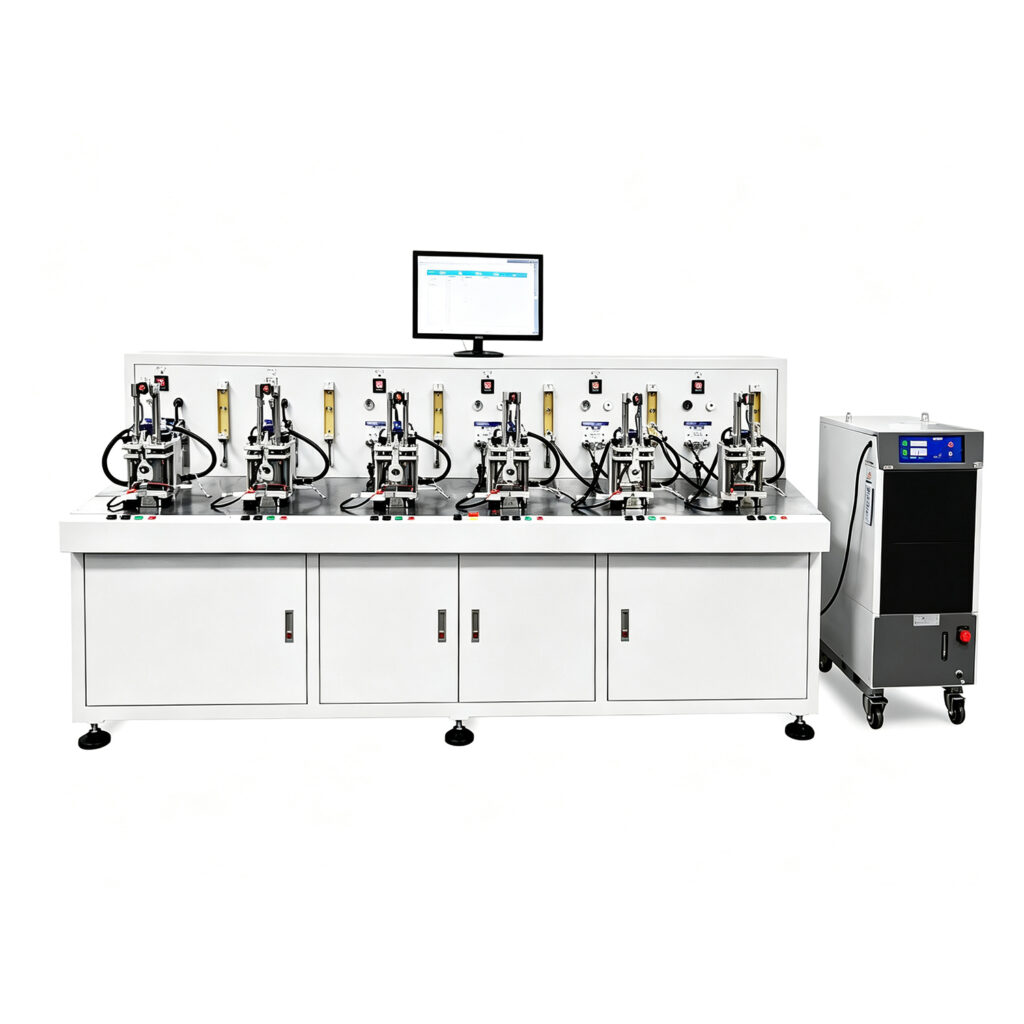
Heat Pipe Powder Filling Machine for Precision Production
1. What Is a Heat Pipe Powder Filling Machine?
A Heat Pipe Powder Filling Machine is specialized manufacturing equipment used to load metal powder into heat pipe tubes during wick production. The powder forms the raw material for a porous wick structure after a suitable forming and sintering process.
Heat pipes transfer thermal energy through the evaporation and condensation of an internal working fluid. Inside the sealed tube, the wick structure helps return condensed liquid toward the heated area through capillary action.
The wick plays an important role in heat pipe operation. Its material, pore structure, thickness, and permeability influence liquid circulation and thermal performance.
Copper powder is common in copper-water heat pipes. Manufacturers place the powder inside a prepared tube and then use a suitable process to form a porous structure. Depending on the design, this may involve mandrels, vibration, compaction, and sintering.
A dedicated powder filling machine helps control how manufacturers introduce powder into the tube. It can reduce manual handling and improve filling consistency across production batches.
However, powder filling is only one stage of wick manufacturing. The final wick quality also depends on powder characteristics, forming conditions, sintering parameters, and process control.
2. Why Powder Filling Matters in Heat Pipe Manufacturing
Powder filling directly influences the material distribution inside the heat pipe. Inconsistent filling can create variations in wick thickness, density, and structure.
These variations may affect capillary performance and the finished product’s heat-transfer capability.
2.1 Building the Porous Wick Structure
A sintered powder wick contains interconnected pores. These pores allow liquid working fluid to move through the heat pipe.
The powder must form a suitable structure after sintering. Particle size, particle shape, and distribution all influence the resulting pore characteristics.
A powder filling machine helps deliver the material into the designated tube section. Manufacturers must still validate the subsequent forming and sintering processes.
2.2 Maintaining Consistent Powder Quantity
Different heat pipe designs require different powder quantities. The required amount depends on tube dimensions, wick thickness, powder properties, and the intended structure.
Too little powder may produce an insufficient wick layer. Excessive powder can reduce the available vapor space or create an unsuitable wick geometry.
Accurate dosing helps manufacturers maintain consistent material quantities. It also makes production records easier to compare.
2.3 Supporting Uniform Powder Distribution
Powder should reach the intended area without creating significant gaps or unwanted accumulation. Uneven distribution may lead to inconsistent wick structures after sintering.
A suitable filling system can improve repeatability. The machine configuration should match the tube length, diameter, and powder characteristics.
2.4 Reducing Manual Handling
Manual powder loading can create variation between operators and production batches. It may also increase material loss and workplace dust.
A dedicated machine can standardize material delivery and reduce repetitive handling. Suitable dust collection and material containment also help maintain a cleaner production environment.
3. How a Heat Pipe Powder Filling Machine Works
The working sequence depends on the equipment design and wick manufacturing method. A typical powder filling process includes several stages.
3.1 Powder Preparation
Manufacturers first prepare the metal powder according to the product specification. They should control particle size distribution, cleanliness, moisture, and material consistency.
For copper-water heat pipes, copper powder is a common wick material. Other designs may use different materials depending on operating conditions and product requirements.
Powder preparation matters because material variation can influence filling behavior and the final sintered structure.
3.2 Tube Loading and Positioning
The operator places the prepared heat pipe tube into the machine fixture. The fixture holds the tube in the correct position during powder loading.
Accurate positioning helps direct powder into the intended section. It also supports consistent filling across different workpieces.
3.3 Powder Metering
The machine delivers a specified quantity of powder into the tube. Depending on the design, the system may use controlled feeding, volumetric dosing, or another metering arrangement.
The suitable method depends on powder flow characteristics and required filling accuracy.
Manufacturers should verify the actual powder quantity through weighing or another validated measurement method. They should not assume that identical machine settings always produce identical powder mass.
3.4 Powder Distribution and Compaction
Some wick designs require additional steps to distribute or compact the powder inside the tube. Equipment may use vibration, mechanical movement, or dedicated tooling.
These operations help position the powder before sintering. The correct approach depends on the desired wick geometry and manufacturing process.
3.5 Transfer to the Sintering Process
After filling and any required forming operation, manufacturers transfer the workpiece to a suitable sintering furnace.
The furnace heats the powder under controlled conditions. This process bonds particles together while retaining a porous structure.
Sintering parameters depend on powder composition, particle size, tube material, and wick design. Manufacturers should establish these parameters through process development and validation.
For related equipment, consider linking to the 🔗 Vacuum Sintering Furnace page, if available on Linkthermal.
4. Common Powder Filling Methods
Different heat pipe products require different powder loading arrangements. Machine selection should reflect the intended wick structure and production volume.
4.1 Controlled Powder Dosing
Controlled dosing delivers a measured quantity of powder into each tube. This approach helps manufacturers maintain material consistency.
It can suit production processes where each product model has a defined powder charge. The dosing system must also handle the powder’s flow characteristics.
4.2 Vibration-Assisted Filling
Some processes use vibration to help powder move through a tube and settle into the required area.
Vibration settings require careful validation. Excessive vibration may cause unwanted powder compaction or segregation, depending on the material and geometry.
4.3 Multi-Station Powder Filling
A multi-station system can support several workpieces during a production cycle. This configuration may improve output when the loading and filling operations allow parallel processing.
However, actual productivity depends on the number of stations, filling time, operator handling, and downstream equipment capacity.
4.4 Customized Filling Solutions
Long tubes, small-diameter tubes, and special wick structures may require customized fixtures or feeding arrangements.
Manufacturers should provide sample tubes and powder specifications before ordering equipment. This allows the supplier to evaluate feeding performance and tooling compatibility.
5. Key Features to Consider
When comparing a Heat Pipe Powder Filling Machine, focus on its ability to handle your powder and tube specifications.
5.1 Powder Feeding Accuracy
The feeding system should deliver a repeatable powder quantity. Ask the supplier how the machine controls and verifies each charge.
Important considerations include:
Target powder weight per tube.
Dosing range and adjustment method.
Repeatability across production cycles.
Compatibility with different powder particle sizes.
Ease of cleaning between material changes
For critical products, request filling tests using your actual copper powder.
5.2 Tube Size Compatibility
The machine should match the tube dimensions used in your production line. Check the supported tube diameter, length, and loading arrangement.
Long and narrow tubes may need special feeding or vibration arrangements. Customized fixtures can help maintain stable positioning during filling.
5.3 Powder Distribution Control
Accurate dosing alone does not guarantee uniform powder distribution. The machine should suit the required wick length and internal geometry.
Ask whether the system supports vibration or other powder-settling functions. Confirm how these functions affect the final powder arrangement.
5.4 Dust Control and Material Containment
Fine metal powders can create dust during handling. Equipment should provide suitable containment and dust management for the material and workplace.
Ask about enclosed feeding areas, extraction connections, cleaning procedures, and operator protection. The safety measures should follow the powder supplier’s safety data sheet and applicable workplace requirements.
5.5 Automation and Process Monitoring
Automation can reduce manual handling and improve production repeatability. Depending on the configuration, useful features may include:
- Automatic tube positioning.
- Programmable powder feeding.
- Vibration control.
- Filling-cycle monitoring.
- Alarm functions.
- Production data recording.
Do not assume every machine includes these functions. Confirm the equipment configuration before comparing suppliers.
6. Benefits for Heat Pipe Manufacturers
A suitable powder filling system can support several improvements in wick manufacturing.
6.1 More Consistent Powder Quantity
Controlled dosing helps reduce variation between tubes. This supports repeatable material preparation and simplifies process monitoring.
6.2 Improved Production Efficiency
Automated feeding can reduce the time operators spend measuring and loading powder. Multi-station designs may also support parallel workpiece processing.
Actual output depends on the filling method, tube dimensions, and downstream process capacity.
6.3 Reduced Material Waste
A controlled feeding arrangement can help reduce powder spillage and unnecessary material loss. Proper collection and reuse procedures may further improve material utilization, where permitted by the powder quality requirements.
Reused powder should not automatically return to production. Manufacturers must assess contamination, oxidation, and particle changes first.
6.4 Better Process Repeatability
Standardized filling settings can help operators follow the same procedure across production batches. This is particularly useful when manufacturers produce several models with defined powder requirements.
6.5 Support for Automated Production
A powder filling machine can connect with other equipment in a heat pipe manufacturing line. This helps manufacturers coordinate powder loading, forming, sintering, and later assembly operations.
7. Applications Across Thermal Management Industries
Sintered powder wicks appear in various heat pipe designs. The filling process must match the intended product structure and operating conditions.
7.1 Computer and Electronics Cooling
Heat pipes help transfer heat away from processors, graphics cards, and other electronic components. Sintered copper powder wicks can support liquid return through capillary action.
7.2 Flat Heat Pipes and Vapor Chambers
Flat heat pipes and vapor chambers may use sintered powder structures. Their internal wick geometry can differ from conventional cylindrical heat pipes.
Powder loading may therefore require different tooling and distribution methods. Manufacturers should validate the filling process against the intended flat or planar structure.
7.3 Industrial Thermal Management
Industrial electronics and selected cooling assemblies use heat pipes to manage concentrated heat loads. Manufacturers may require different wick structures to meet their operating conditions.
7.4 Customized Heat Pipe Products
Specialized heat pipes may require customized powder quantities, wick thicknesses, or layered structures. Flexible feeding systems can help manufacturers handle different product specifications.
Research confirms that powder particle size and shape influence the porosity and capillary behavior of sintered copper wicks. These properties affect the final heat pipe design.
8. How to Choose the Right Heat Pipe Powder Filling Machine
A structured evaluation helps manufacturers select equipment that fits their production requirements.
8.1 Define Your Powder Specifications
Prepare the powder information before requesting a quotation. Include:
- Powder material and grade.
- Particle size distribution.
- Particle shape.
- Bulk density.
- Moisture and cleanliness requirements.
- Target powder quantity per tube.
These properties influence feeding behavior. Two powders with similar nominal particle sizes may still flow differently.
8.2 Provide Tube Drawings
Share the tube dimensions and internal wick design. Include tube diameter, length, wall thickness, and the required powder-filled area.
If the product uses a central mandrel or special internal structure, show this clearly in the drawing.
8.3 Confirm Filling Accuracy
Ask the supplier to demonstrate the filling process with your powder and tubes. Measure the actual powder quantity across multiple cycles.
Compare the results against your approved tolerance. Also check whether the machine maintains repeatability after product changeovers.
8.4 Evaluate Production Capacity
Estimate your daily output and production schedule. Consider the full cycle, including loading, positioning, filling, vibration, and unloading.
A multi-station machine may suit higher-volume production. A simpler system may be more practical for smaller batches or frequent product changes.
8.5 Check Cleaning and Maintenance
Powder residue can affect later production batches. Ask how operators clean the feeding system, fixtures, and powder-contact surfaces.
Also review wear parts, maintenance access, spare parts, and operator training.
8.6 Request a Sample Production Trial
A sample trial provides practical evidence of equipment suitability. Ask the supplier to evaluate:
- Powder feeding consistency.
- Filling time.
- Powder distribution.
- Material loss.
- Tube handling.
- Repeatability across multiple samples.
Where possible, inspect the resulting wick after sintering. This provides more useful information than evaluating the powder loading operation alone.
9. Integration with a Heat Pipe Production Line
A Heat Pipe Powder Filling Machine usually works as part of a larger manufacturing process. Its position depends on the heat pipe structure and the selected wick-forming method.
A typical manufacturing workflow may include:
- Copper tube cutting and preparation.
- Tube cleaning and drying.
- Wick powder preparation.
- Powder filling and distribution.
- Mandrel positioning or other internal forming operations, where required.
- Sintering under controlled conditions.
- Tube assembly and end closure.
- Evacuation and working-fluid filling.
- Filling-port sealing and welding.
- Leak inspection and thermal performance testing.
The exact process varies between heat pipe designs. Some products use loose-powder sintering, while others require additional forming or support structures.
9.1 Coordinate Powder Filling with Sintering
Powder filling and sintering should work as a coordinated process. The filling stage determines the initial powder arrangement. Sintering then develops the bonded porous structure.
The final wick properties depend on powder characteristics and process conditions. Research shows that particle size, particle shape, and sintering conditions influence wick porosity and capillary behavior.
For this reason, manufacturers should validate the complete process rather than evaluating filling accuracy alone.
9.2 Connect with Other Manufacturing Equipment
Depending on the production plan, manufacturers may combine the powder filling machine with:
🔗 Heat Pipe Filling & Welding Machine
🔗 Heat Pipe Multi-station Dry-out Tester
🔗 Heat Pipe Thermal Performance Tester
These are recommended internal-link opportunities. Add links only when the corresponding product pages exist on Linkthermal.
10. Common Powder Filling Problems and Solutions
Powder feeding problems can affect the wick structure and increase production variation. The following table summarizes common issues and possible corrective actions.
Problem | Possible cause | Recommended action |
Inconsistent powder quantity | Unstable feeding or incorrect dosing settings | Check the feeding mechanism and verify powder weight |
Uneven powder distribution | Poor tube positioning or unsuitable vibration settings | Review fixtures and distribution parameters |
Powder blockage | Poor flowability or unsuitable feeding geometry | Check powder properties and clean the feeding path |
Excessive powder loss | Poor containment or uncontrolled discharge | Improve collection and material handling |
Different wick thicknesses | Inconsistent powder loading or forming conditions | Review filling and downstream forming procedures |
Contamination between batches | Inadequate cleaning | Establish a documented cleaning procedure |
10.1 Control Powder Properties
Powder properties can change how material flows through the feeding system. Particle shape, particle size distribution, and bulk density all matter.
Manufacturers should use qualified powder materials and monitor changes between batches.
10.2 Verify Filling Weight
Do not rely only on machine settings. Periodically check the actual powder weight delivered into each tube.
This helps identify feeding variation before it affects a larger production batch.
10.3 Inspect the Finished Wick
Powder weight is only one part of wick quality. Manufacturers should also inspect the sintered structure when developing or validating a process.
Relevant properties may include porosity, permeability, pore distribution, and wick thickness. These properties help determine whether the wick meets the product’s capillary requirements.
11. Frequently Asked Questions
11.1 What does a Heat Pipe Powder Filling Machine do?
It loads metal powder into heat pipe tubes to prepare the material for wick formation. The powder typically undergoes a subsequent forming and sintering process.
11.2 Which powder is commonly used for heat pipe wicks?
Copper powder is widely used in copper-water heat pipes. Other materials may suit specialized designs and operating conditions.
The correct powder depends on the tube material, working fluid, wick design, and manufacturing process.
11.3 Why is powder filling accuracy important?
The powder quantity influences the initial wick material distribution. Inconsistent loading can produce variations in wick thickness and structure after sintering.
Controlled filling helps manufacturers improve process repeatability.
11.4 Does powder particle size affect heat pipe performance?
Yes. Particle size influences pore structure, porosity, permeability, and capillary behavior after sintering.
However, there is no single ideal particle size for every heat pipe. Manufacturers must select powder based on the required wick characteristics and validate the finished structure.
11.5 Can one machine handle different powder sizes?
This depends on the feeding mechanism and equipment configuration. Different powder sizes and shapes may have different flow characteristics.
Buyers should test their actual materials before confirming machine suitability.
11.6 Does a powder filling machine include a sintering furnace?
Not necessarily. Some production lines integrate multiple operations, while others use separate machines.
Confirm whether the quotation includes powder feeding, vibration, forming, sintering, or only selected functions.
11.7 How do manufacturers check wick quality?
They can evaluate powder quantity, wick dimensions, porosity, permeability, and capillary performance. The specific inspection methods depend on the product and quality requirements.
Thermal performance testing can provide additional evidence of finished heat pipe behavior.
11.8 What information should I provide when requesting a quotation?
Provide powder specifications, tube drawings, target powder quantity, wick dimensions, and expected production capacity.
Sample materials also help suppliers evaluate feeding performance and recommend suitable tooling.
12. Conclusion
A Heat Pipe Powder Filling Machine supports the preparation of sintered powder wicks in heat pipe manufacturing. It helps control powder delivery, reduce manual handling, and improve production consistency.
The right equipment depends on powder properties, tube dimensions, wick geometry, and required output. Manufacturers should also consider how powder filling connects with forming and sintering operations.
Before purchasing, provide representative powder samples and tube drawings. Request a production trial and inspect the resulting wick structure.
For manufacturers planning to improve their heat pipe production process, Linkthermal can present suitable powder filling equipment and related manufacturing solutions based on actual production requirements.