
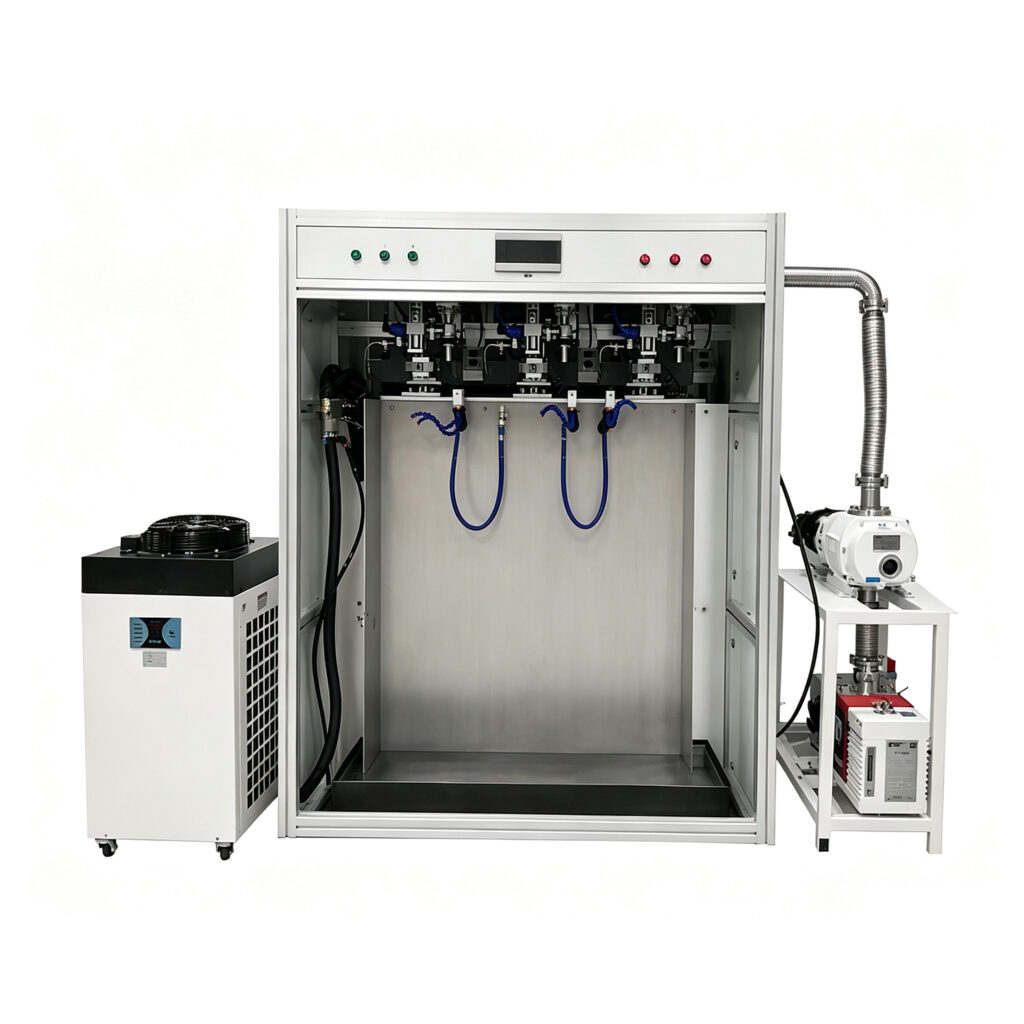
Heat Pipe Equipment Production Line: Complete Guide
Introduction
Heat pipes play an important role in modern thermal management. They transfer heat efficiently in electronics, telecommunications equipment, industrial systems, and power electronics.
As electronic devices become smaller and more powerful, manufacturers face increasing thermal challenges. Therefore, reliable heat pipe manufacturing equipment has become essential for producing consistent thermal components.
A Heat Pipe Equipment Production Line combines specialized machines, process controls, and inspection systems. Together, these systems support the production of heat pipes with stable dimensions and reliable thermal performance.
However, producing a heat pipe involves more than filling a copper tube with working fluid. Manufacturers must prepare the casing, install the wick structure, remove non-condensable gases, charge the correct fluid quantity, and seal the pipe reliably.
Each stage influences the finished product. Consequently, equipment selection should reflect the intended heat pipe design, production capacity, and quality requirements.
This guide explains the main machines, manufacturing stages, automation options, and selection criteria for a complete heat pipe production line. It also introduces how linkthermal relates to thermal management manufacturing equipment.
1. What Is a Heat Pipe Equipment Production Line?
A Heat Pipe Equipment Production Line is a coordinated manufacturing system for producing heat pipes used in thermal management applications.
The line combines individual machines that perform tube preparation, wick processing, cleaning, evacuation, fluid charging, sealing, and quality testing.
Depending on the product design, manufacturers may also need forming, flattening, bending, or cutting equipment.
The exact configuration varies with heat pipe diameter, length, wick structure, working fluid, and target production volume.
A typical production line may include:
- Copper tube cutting and preparation equipment
- Heat pipe necking or end-forming machines
- Wick insertion and assembly tools
- Cleaning equipment
- Vacuum pumping and degassing systems
- Working fluid filling equipment
- Heat pipe filling and welding machines
- Sealing and welding equipment
- Leak testing equipment
- Thermal performance testing systems
Not every factory needs every machine. For example, a manufacturer that purchases prepared copper tubes may not require an integrated tube-forming station.
Similarly, prototype workshops may prefer flexible standalone machines. High-volume factories, by contrast, often benefit from automated handling and integrated process controls.
Therefore, manufacturers should define their product range before selecting equipment.
🔗 Internal link opportunity: Heat Pipe Production Line — Link to the relevant production-line overview or product page on linkthermal.com.
2. How Does a Heat Pipe Work?
Understanding the operating principle helps manufacturers identify the process requirements.
A heat pipe transfers heat through evaporation and condensation inside a sealed enclosure.
First, heat enters the evaporator section. The working fluid absorbs this energy and evaporates.
Next, the vapor moves toward the cooler condenser section. There, the vapor releases latent heat and condenses.
Meanwhile, a wick structure returns the liquid toward the evaporator through capillary action.
This cycle allows a heat pipe to transfer heat efficiently without requiring continuous mechanical pumping.
However, the process depends on several manufacturing conditions.
The enclosure must maintain the required internal pressure. The working fluid must match the intended operating temperature range. In addition, the wick must support liquid return.
Non-condensable gases can interfere with vapor movement and reduce effective heat transfer. Consequently, vacuum processing and reliable sealing are important production stages.
Manufacturers must also control fluid quantity. Too little fluid may limit liquid return, while excessive fluid can affect vapor space and performance.
Therefore, production equipment must support consistent preparation, charging, and sealing.
3. Main Equipment in a Heat Pipe Production Line
An integrated line contains several machines with different responsibilities.
3.1 Copper Tube Cutting Machine
The cutting machine prepares copper tubes to the required length.
Consistent cutting helps maintain dimensional accuracy and supports downstream assembly.
Furthermore, clean tube ends simplify later forming and sealing operations.
🔗 Internal link: Heat Pipe Cutting Machine
3.2 Heat Pipe Necking Machine
A necking machine reduces the diameter of selected tube sections.
Manufacturers use this process when the design requires a narrowed end or a specific sealing geometry.
However, excessive deformation can damage the tube or affect wall thickness.
Therefore, tooling and forming parameters must match the tube material and dimensions.
🔗 Internal link: Heat Pipe Necking Machine
3.3 Wick Insertion Equipment
The wick structure supports capillary liquid return inside the heat pipe.
Common wick designs include sintered powder structures, mesh, and grooved surfaces.
The appropriate design depends on heat load, orientation, operating temperature, and application requirements.
Equipment may position the wick, support assembly, or prepare the tube for subsequent processing.
For sintered copper powder wicks, manufacturers may require a dedicated powder filling process and controlled thermal treatment.
🔗 Internal link: Heat Pipe Powder Filling Machine
3.4 Vacuum Sintering Furnace
Some heat pipe designs use sintered copper powder to create a porous wick structure.
A vacuum sintering furnace supports controlled heating under suitable atmospheric conditions.
The process helps bond powder particles while maintaining the porosity required for capillary action.
However, temperature, holding time, atmosphere, and powder characteristics require careful optimization.
Not every heat pipe uses a sintered powder wick. Therefore, manufacturers should select this equipment only when their design requires it.
🔗 Internal link: Vacuum Sintering Furnace
3.5 Vacuum Degassing Equipment
Vacuum processing removes air and other non-condensable gases from the heat pipe.
These gases can interfere with vapor movement and reduce the effective condenser area.
Therefore, vacuum pumping and degassing equipment play an important role in manufacturing quality.
The required configuration depends on internal volume, materials, process sequence, and target cleanliness.
🔗 Internal link: Heat Pipe Vacuum Degassing Machine
3.6 Working Fluid Filling Machine
The filling machine introduces a controlled quantity of working fluid into the prepared heat pipe.
Water commonly serves as the working fluid in many copper heat pipes. Other fluids may suit different operating temperatures and materials.
Consequently, manufacturers must match the fluid to the application.
Accurate dosing helps maintain consistent thermal performance. Furthermore, suitable fluid handling procedures reduce contamination and improve process repeatability.
🔗 Internal link: Heat Pipe Filling Machine
3.7 Heat Pipe Filling and Welding Machine
Some production systems combine fluid charging with sealing operations.
After the required evacuation and filling steps, the equipment closes the filling port or tube end.
Depending on the design, manufacturers may use laser welding, resistance welding, or another suitable joining method.
The selected process must create a reliable seal without damaging the enclosure or internal components.
🔗 Internal link: Heat Pipe Filling & Welding Machine
3.8 Leak Testing Equipment
Leak testing checks whether the sealed heat pipe meets the required integrity standard.
The appropriate method depends on the product design, acceptance criteria, and production requirements.
Manufacturers should establish clear testing procedures before mass production.
Additionally, they should separate process monitoring from final acceptance testing when the quality plan requires both.
🔗 Internal link: Heat Pipe Leak Tester
3.9 Thermal Performance Testing Equipment
Thermal testing evaluates whether the finished heat pipe performs as intended.
Depending on the product, testing may assess thermal resistance, heat transfer capability, temperature distribution, or other specified characteristics.
These results help manufacturers verify process consistency.
🔗 Internal link: Heat Pipe Thermal Performance Tester
4. Heat Pipe Manufacturing Process Step by Step
A typical heat pipe manufacturing process follows several stages. However, the exact sequence depends on the wick design and assembly method.
Step 1: Tube Preparation
First, manufacturers select copper tubes that meet the product specifications.
The cutting equipment prepares each tube to the required length. Operators then inspect the tube for visible defects and dimensional deviations.
Step 2: Tube Forming
Next, the manufacturer performs any required necking, bending, flattening, or end forming.
The process must preserve suitable wall thickness and prevent unwanted deformation.
Step 3: Wick Preparation and Assembly
The manufacturer prepares the wick structure according to the heat pipe design.
For a sintered wick, the process may involve powder filling and vacuum sintering. Other designs may require mesh insertion or different internal structures.
Consequently, the production line must match the selected wick technology.
Step 4: Cleaning
The manufacturer removes oil, particles, and other contaminants from the tube and relevant components.
Clean internal surfaces help reduce contamination during later vacuum and filling operations.
Step 5: Evacuation and Degassing
The equipment removes air and other unwanted gases from the heat pipe.
Manufacturers must follow a validated procedure to achieve the required internal condition.
Step 6: Working Fluid Charging
The filling equipment introduces the specified working fluid.
Accurate dosing helps maintain consistent performance across production batches.
Step 7: Sealing
The machine closes the filling port or tube end.
Manufacturers select the sealing process according to material thickness, geometry, and product requirements.
Step 8: Leak Inspection
The finished pipe undergoes a suitable leak test.
This stage helps identify defective seals before further testing or shipment.
Step 9: Thermal Performance Testing
Finally, the manufacturer evaluates thermal performance against the product specifications.
The test results help confirm whether the heat pipe meets the required criteria.
5. Types of Heat Pipe Production Lines
Manufacturers should select a production line based on product complexity and expected demand.
5.1 Prototype and Laboratory Production Line
A prototype line supports product development and process experimentation.
It often uses standalone equipment and flexible tooling.
This configuration suits research teams, thermal engineers, and manufacturers developing new heat pipe designs.
However, operators may need to perform more manual handling.
5.2 Semi-Automatic Heat Pipe Production Line
A semi-automatic line combines specialized machines with manual loading or transfer.
This arrangement offers a balance between equipment investment and production consistency.
It can suit factories with moderate output or multiple product variants.
5.3 Fully Automatic Heat Pipe Production Line
A fully automatic line integrates material handling, processing, and control functions.
Depending on the design, it may reduce manual intervention and support higher throughput.
However, automation requires careful coordination between stations.
Manufacturers must also consider tooling changes, maintenance access, and process monitoring.
5.4 Customized Heat Pipe Manufacturing Line
Some applications require special tube dimensions, wick structures, or sealing processes.
A customized line can combine selected equipment around these requirements.
For example, a manufacturer producing flattened heat pipes may need additional forming equipment.
Therefore, customization should begin with product drawings and a clearly defined manufacturing process.
6. Benefits of an Integrated Production Line
An integrated heat pipe production line offers several potential advantages.
Improved Process Consistency
Coordinated equipment helps standardize critical manufacturing stages.
Furthermore, validated process settings reduce unnecessary variation between batches.
Better Production Flow
Integrated stations reduce unnecessary movement between operations.
Consequently, manufacturers can organize material flow more efficiently.
Reduced Manual Handling
Automation can reduce repetitive tasks and support more consistent material transfer.
However, operators still need appropriate training and quality oversight.
Easier Quality Management
A structured production line helps manufacturers identify where defects occur.
Additionally, process records can support troubleshooting and continuous improvement.
More Predictable Production Planning
When manufacturers understand each station’s capacity, they can identify bottlenecks more effectively.
This information supports production scheduling and equipment investment decisions.
Flexible Expansion
A modular production line can allow manufacturers to add capacity as demand grows.
However, expansion requires compatible machine interfaces and sufficient factory space.
7. Key Factors Affecting Heat Pipe Quality
The equipment alone does not determine finished product quality. Manufacturers must also control the process.
Wick Structure
The wick affects capillary return and operating performance.
Its pore structure, permeability, thickness, and contact with the enclosure all matter.
Therefore, manufacturers should validate the wick design against the intended heat load and orientation.
Working Fluid Quantity
The working fluid must match the heat pipe’s internal volume and design.
An unsuitable charge can limit performance or affect vapor space.
Consequently, manufacturers should establish a validated filling specification.
Internal Cleanliness
Contaminants can affect internal conditions and working fluid behavior.
Therefore, cleaning and material handling require consistent procedures.
Vacuum Quality
Non-condensable gases can reduce effective heat transfer.
Proper evacuation and process control help address this risk.
Sealing Integrity
Leakage can change the internal pressure and working fluid quantity.
Therefore, manufacturers should verify seal integrity through suitable testing.
Dimensional Accuracy
Tube diameter, length, flatness, and end geometry can affect assembly and application fit.
Consequently, manufacturers should monitor dimensions throughout production.
8. How to Choose the Right Production Equipment
Before requesting a quotation, prepare the following information.
- Product type: Identify the heat pipe design and intended application.
- Tube dimensions: Provide length, diameter, wall thickness, and material.
- Wick structure: Specify sintered powder, mesh, grooves, or another design.
- Working fluid: Identify the fluid and operating temperature requirements.
- Production capacity: Define target output per shift or month.
- Automation level: Decide whether manual, semi-automatic, or automatic processing suits the factory.
- Quality requirements: Specify leak testing, thermal testing, and dimensional tolerances.
- Factory conditions: Confirm available floor space, power, cooling, and vacuum utilities.
- Future expansion: Consider planned capacity increases and product variants.
- Technical support: Clarify installation, commissioning, training, and spare parts.
With these details, suppliers can recommend suitable machines and production-line configurations.
Furthermore, manufacturers should request sample trials when the process involves new wick structures or sealing methods.
9. Automation and Production Efficiency
Automation can improve repeatability, but its value depends on the production process.
For example, automated fluid dosing helps control working fluid quantity. Meanwhile, programmable sealing systems support consistent operation across repeated cycles.
Integrated controls can also reduce unnecessary operator movement.
However, automation does not automatically eliminate defects. Poor process design can create repeated problems at a larger scale.
Therefore, manufacturers should validate individual stations before integrating the complete line.
Identify Production Bottlenecks
Measure the cycle time of each manufacturing stage.
Next, compare station capacity to identify the slowest operation.
This approach helps manufacturers focus investment where it can improve overall throughput.
Standardize Process Parameters
Document approved settings for each product model.
Additionally, maintain records of process deviations and corrective actions.
Plan for Maintenance
Include routine inspection and preventive maintenance in the production schedule.
Consequently, manufacturers can reduce unexpected downtime.
10. Heat Pipe Equipment Applications
Heat pipe manufacturing equipment supports several industries.
Consumer Electronics
Heat pipes help transfer heat away from processors and other compact electronic components.
Therefore, manufacturers need consistent dimensions and thermal performance.
Computer and Server Cooling
High-performance computers and servers generate substantial heat.
Heat pipes can transfer this heat toward compatible cooling assemblies.
Telecommunications Equipment
Telecommunications devices require reliable thermal management during continuous operation.
Consequently, manufacturers use heat pipes in suitable cooling designs.
Industrial Electronics
Power supplies, control systems, and industrial electronics may use heat pipes to manage local heat loads.
Automotive Electronics
Automotive control units and power electronics face demanding thermal conditions.
Manufacturers must select suitable heat pipe designs and validate them against operating requirements.
Renewable Energy Equipment
Some renewable energy systems use heat pipes for thermal transfer or temperature control.
The appropriate equipment configuration depends on the specific application and product design.
11. Production Costs and Return on Investment
The cost of a heat pipe production line depends on its configuration.
Standalone equipment generally requires a different investment from a fully integrated automated line.
Key cost factors include:
- Number and type of machines
- Automation and material handling
- Vacuum and filling systems
- Welding and sealing technology
- Inspection and testing equipment
- Tooling and product changeover
- Installation and commissioning
- Maintenance and spare parts
However, purchase price alone does not determine the best investment.
Manufacturers should also evaluate labor requirements, material yield, consumable use, cycle time, and defect rates.
A simple approach compares the total operating cost per qualified heat pipe.
This calculation should include production losses and inspection costs.
Additionally, manufacturers should estimate the expected output under realistic operating conditions rather than relying solely on theoretical machine speed.
12. Why Consider linkthermal?
Choosing heat pipe manufacturing equipment requires an understanding of the complete production process.
linkthermal focuses on thermal management manufacturing equipment, including vapor chamber production systems, heat pipe manufacturing equipment, and related thermal processing solutions.
For manufacturers planning a new heat pipe factory, equipment compatibility is particularly important.
For example, powder filling and sintering must match the selected wick structure. Similarly, vacuum processing, fluid charging, and sealing must work together.
Therefore, buyers should evaluate the production line as a coordinated system rather than a collection of unrelated machines.
When discussing a project with linkthermal, prepare product drawings, target output, material specifications, wick design, and automation requirements.
These details help clarify the required equipment configuration.
You can visit the official website at https://linkthermal.com/ to explore the company’s equipment portfolio and available solutions.
Before making a purchase, confirm the availability and specifications of each machine directly with the supplier.
13. Frequently Asked Questions
What is a heat pipe equipment production line?
A heat pipe equipment production line combines machines for tube preparation, wick assembly, vacuum processing, fluid filling, sealing, and testing.
The exact configuration depends on the product design and production volume.
What machines are required to manufacture heat pipes?
Typical equipment includes tube cutting, forming, cleaning, vacuum degassing, fluid filling, sealing, leak testing, and thermal testing machines.
Manufacturers may also need powder filling and sintering equipment for selected wick structures.
Does every heat pipe require a vacuum sintering furnace?
No. A vacuum sintering furnace suits heat pipes that use a sintered powder wick.
Other wick designs may require different preparation equipment.
Why does a heat pipe require vacuum processing?
Vacuum processing removes air and other non-condensable gases.
These gases can interfere with vapor movement and reduce thermal performance.
How does working fluid filling affect heat pipe performance?
Working fluid quantity influences evaporation, condensation, and liquid return.
Therefore, manufacturers should establish and maintain suitable filling specifications.
Can a heat pipe production line be fully automated?
Yes. Manufacturers can integrate compatible machines and material handling systems.
However, the automation level depends on product complexity, output targets, and budget.
How can manufacturers improve heat pipe production quality?
Control wick structure, internal cleanliness, vacuum conditions, fluid quantity, sealing integrity, and thermal performance.
Additionally, maintain consistent process records and inspection procedures.
How much does a heat pipe production line cost?
The cost depends on machine configuration, automation, output capacity, testing requirements, and installation needs.
Manufacturers should provide product specifications before requesting a quotation.
What information should buyers provide to an equipment supplier?
Provide tube dimensions, wick design, working fluid, target production volume, quality requirements, and factory conditions.
Product drawings and sample specifications can help suppliers recommend suitable equipment.
Where can I find heat pipe manufacturing equipment?
You can explore thermal manufacturing equipment through linkthermal at https://linkthermal.com/.
Confirm individual machine specifications and availability before purchasing.
14. Conclusion
A Heat Pipe Equipment Production Line supports the manufacturing of reliable thermal management components.
The line combines tube preparation, wick processing, vacuum treatment, fluid charging, sealing, and quality inspection.
Each stage contributes to finished product performance. Therefore, manufacturers should design the production process around their heat pipe specifications.
An integrated line can improve process consistency and production flow. However, the best configuration depends on product design, target output, and investment priorities.
Before purchasing equipment, evaluate the wick structure, working fluid, automation level, inspection requirements, and future expansion plans.
linkthermal provides a starting point for manufacturers exploring thermal management production equipment.
Visit https://linkthermal.com/ to review the company’s equipment portfolio and discuss your manufacturing requirements.