
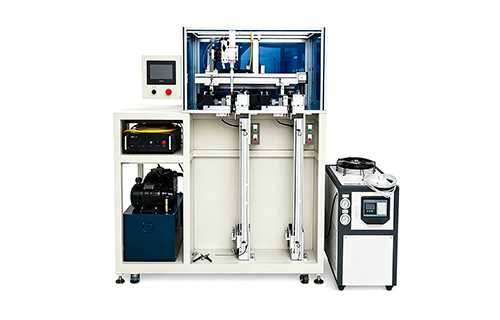
Ultra-thin Vapor Chamber Laser Sealing Machine Guide
1. What Is an Ultra-thin Vapor Chamber Laser Sealing Machine?
An Ultra-thin Vapor Chamber Laser Sealing Machine is specialized equipment for joining the thin metal plates that form a vapor chamber. It uses a focused laser beam to create a continuous weld along the designed sealing path.
Vapor chambers transfer heat through a phase-change process. Inside the sealed chamber, a working fluid evaporates near the heat source. The vapor then moves toward cooler regions and releases heat through condensation. A wick structure returns the liquid to the heated area.
This process supports efficient heat spreading in compact electronic devices. However, the chamber must maintain a suitable internal environment to perform reliably.
Manufacturers therefore need precise sealing technology. The equipment must join the metal plates without compromising the chamber’s geometry, wick structure, or sealing integrity.
Ultra-thin designs make this requirement more demanding. Thin plates can deform under excessive heat or unsuitable clamping pressure. Even small defects may affect product quality.
A properly configured laser sealing system helps manufacturers control several critical factors:
- Weld position and seam consistency
- Laser power and processing speed
- Heat input and thermal distortion
- Fixture alignment and workpiece stability
- Weld appearance and repeatability
- Compatibility with inspection and automation systems
The machine’s configuration should match the product’s material, thickness, dimensions, and production requirements. Manufacturers should validate these factors through sample testing before full-scale production.
2. Why Laser Sealing Matters for Ultra-thin Vapor Chambers
2.1 Increasing Demand for Compact Thermal Solutions
Electronic devices continue to combine higher computing performance with thinner product designs. Smartphones, tablets, gaming laptops, and other compact systems must manage concentrated heat within limited space.
Ultra-thin vapor chambers help spread heat across a larger surface. This approach can improve temperature uniformity while preserving valuable internal space.
However, thinner chambers create stricter manufacturing requirements. The sealing process must protect the thin shell while maintaining a continuous joint.
Research published in Applied Thermal Engineering examined the performance and reliability of an ultra-thin vapor chamber with a thickness of 0.32 mm. The study highlighted the importance of vacuum processing and reliable sealing for thermal performance.
2.2 Controlling Heat Input
Laser welding concentrates energy within a defined processing area. This localized heating can reduce unnecessary thermal exposure compared with less localized joining processes.
Nevertheless, laser welding does not eliminate distortion automatically. Excessive power, poor fixturing, or an unsuitable welding path can still damage thin components.
Manufacturers should optimize laser power, pulse settings where applicable, welding speed, focal position, and clamping conditions. These parameters work together to determine weld quality.
2.3 Maintaining Seal Integrity
A vapor chamber relies on a sealed internal cavity. A defective weld may allow gas to enter or working fluid to escape.
Such defects can affect the chamber’s ability to transfer heat. They can also reduce product reliability during service.
A precision sealing process must therefore deliver both suitable weld strength and leak-tight performance. Visual inspection alone cannot confirm hermeticity.
Manufacturers should select an appropriate leak-testing method and establish acceptance criteria for their specific product.
2.4 Supporting Consistent Production
Manual welding can introduce variation between operators and production shifts. Automated laser systems can improve repeatability through programmed paths and controlled processing parameters.
With suitable fixtures and monitoring, manufacturers can also reduce positioning errors and unnecessary rework.
These benefits depend on proper machine setup, operator training, maintenance, and process validation.
3. How the Laser Sealing Process Works
The exact workflow depends on the vapor chamber design and production strategy. A typical process includes the following stages.
3.1 Prepare the Metal Plates
Manufacturers first prepare the upper and lower chamber plates. Depending on the design, these components may use copper or another suitable material.
The preparation stage may include cutting, stamping, forming, cleaning, and dimensional inspection.
Operators should check the sealing edges for contamination, burrs, and deformation. Clean and consistent joining surfaces help reduce weld defects.
3.2 Install the Wick Structure
The wick structure supports liquid return inside the chamber. Its material and geometry depend on the required thermal performance and product design.
Operators must position the wick correctly before closing the chamber. Incorrect placement may interfere with assembly or internal fluid circulation.
The fixture should hold the plates securely without crushing the wick or changing the intended cavity geometry.
3.3 Align and Clamp the Workpiece
The machine fixture positions the plates along the required sealing path. Accurate alignment helps maintain consistent seam placement.
Clamping pressure also matters. Insufficient pressure may leave gaps between the plates. Excessive pressure may deform the thin shell.
Manufacturers should develop a fixture design that balances stability, accessibility, and dimensional protection.
3.4 Perform Laser Sealing
The laser follows a programmed path around the designated joint. The process melts the joining material locally and forms a continuous weld after solidification.
The appropriate settings depend on material type, plate thickness, joint design, and required production speed.
A stable process should avoid incomplete fusion, excessive penetration, burn-through, and unnecessary distortion.
Manufacturers should establish validated parameter windows rather than relying on one setting for every product.
3.5 Inspect the Weld
After welding, operators or automated systems inspect the seam. Common checks include weld continuity, surface appearance, positioning, and visible defects.
Dimensional inspection can identify deformation around the sealing edge. Leak testing can then verify whether the finished chamber meets its specified sealing requirements.
3.6 Complete Vacuum Processing and Filling
Laser sealing and final chamber closure are not always the same operation. Some designs require additional evacuation, working-fluid filling, or sealing of a dedicated filling port.
The correct sequence depends on the chamber architecture and manufacturing method. Manufacturers should confirm whether the equipment performs perimeter sealing, filling-port sealing, or both.
For broader process coordination, link this page to the relevant 🔗 Vapor Chamber Vacuum Filling & Welding Machine product page, if available.
4. Key Features of a Precision Laser Sealing Machine
When evaluating an Ultra-thin Vapor Chamber Laser Sealing Machine, manufacturers should consider the following features.
Feature | Why it matters |
Adjustable laser parameters | Supports process development for different materials and thicknesses |
Precision positioning | Keeps the weld aligned with the designed sealing path |
Stable clamping fixture | Reduces movement and helps control workpiece deformation |
Programmable welding path | Improves repeatability across production batches |
Process monitoring | Helps operators identify parameter deviations |
Compatible inspection systems | Supports more consistent quality verification |
Automation interfaces | Simplifies integration with upstream and downstream equipment |
Recipe management | Helps control product-specific processing settings |
Maintainable laser and optical systems | Supports stable operation over time |
These features should reflect the manufacturer’s actual product requirements. Not every application needs a fully automated system.
For example, a pilot production facility may prioritize flexible tooling and quick parameter adjustment. A high-volume factory may place greater emphasis on automatic loading, cycle-time consistency, and production traceability.
Before purchasing, buyers should request a machine demonstration using representative workpieces. They should also verify the equipment’s achievable performance under realistic production conditions.
5. Main Benefits for Vapor Chamber Manufacturers
5.1 Improved Sealing Precision
A controlled laser path helps maintain a consistent weld location. This is especially useful when the sealing margin is narrow.
Precision also supports product designs with complex outlines. However, the achievable accuracy depends on the motion system, fixture, sensing technology, and workpiece tolerances.
5.2 Reduced Thermal Distortion Risk
Ultra-thin metal plates are sensitive to localized stress and heat. Laser processing concentrates energy near the joint, helping limit unnecessary heating.
Manufacturers must still optimize the process. Appropriate clamping, heat management, and welding sequences remain essential.
5.3 Better Process Repeatability
Programmed processing parameters help reduce variation between batches. Operators can use qualified recipes for different product models.
This approach also makes troubleshooting easier. When a defect appears, engineers can compare process records and identify possible causes.
5.4 Potential for Higher Production Efficiency
Automated laser sealing can reduce repetitive manual work. It can also shorten handling time when integrated with suitable loading and inspection systems.
Actual throughput depends on seam length, workpiece geometry, welding speed, loading time, and inspection requirements.
Manufacturers should compare complete cycle times instead of relying only on the laser’s travel speed.
5.5 Easier Production-Line Integration
A laser sealing station can form part of a broader vapor chamber manufacturing system. Depending on the factory layout, it may connect with plate preparation, assembly, filling, vacuum processing, and testing equipment.
This integration can help improve material flow and production traceability.
Related internal links may include 🔗 Vapor Chamber Production Line, 🔗 Vapor Chamber Fully Automatic Laser Sealing Machine, and 🔗 Vapor Chamber Thermal Performance Tester, where corresponding pages are available.
6. Applications Across Modern Electronics
6.1 Smartphones and Tablets
Smartphones and tablets have limited internal space. At the same time, processors, displays, cameras, and wireless components generate heat.
Ultra-thin vapor chambers help spread heat within slim device profiles. Their production requires careful control of plate flatness and sealing quality.
A suitable laser sealing machine can support repeatable manufacturing of these compact thermal components.
6.2 Gaming Laptops and High-Performance Computers
Gaming laptops and compact computers often combine powerful processors with restricted airflow.
Vapor chambers can distribute heat from concentrated sources across a larger area. This helps thermal engineers design compact cooling assemblies.
Manufacturers must select sealing equipment that matches the chamber’s dimensions, material, and required production volume.
6.3 AI and High-Performance Computing Hardware
AI accelerators and other high-performance computing components create demanding thermal management requirements.
Vapor chambers may serve as part of a larger cooling solution. Their effectiveness depends on the complete thermal design, including contact resistance, heat-source distribution, and downstream cooling.
Laser sealing equipment supports the manufacturing process by helping create consistent chamber joints. It does not, by itself, determine the finished product’s thermal performance.
6.4 Other Compact Electronic Systems
Ultra-thin vapor chambers may also support thermal management in portable devices, communication hardware, and specialized electronic assemblies.
Each application has different requirements for dimensions, reliability, and thermal performance. Equipment selection should therefore begin with the target component specifications.
7. How to Select the Right Machine
Choosing an Ultra-thin Vapor Chamber Laser Sealing Machine requires more than comparing laser power or purchase price.
7.1 Confirm the Product Thickness
Start with the actual thickness range of the chamber plates and the completed product. Thin materials may require more precise control over energy input and clamping.
Do not assume that one machine configuration can process every thickness without adjustment.
7.2 Identify the Material and Joint Design
Copper, stainless steel, and other materials respond differently to laser energy. Surface condition and joint geometry also influence the welding process.
Provide the supplier with material specifications, drawings, and representative samples.
7.3 Define Required Output
Estimate daily output, operating hours, changeover frequency, and expected product mix.
A machine for small-batch production may need flexible tooling. A high-volume system may require automated handling and in-line inspection.
7.4 Evaluate Quality Requirements
Define the required weld appearance, dimensional tolerances, and leak-test criteria.
Ask the supplier how the machine supports these requirements. Request sample results and clarify which tests the supplier performs.
Avoid relying on general claims such as “zero defects” without documented acceptance criteria.
7.5 Review Automation and Maintenance
Consider recipe storage, fixture changes, operator access, safety systems, and maintenance requirements.
Also check the availability of technical support and replacement components. These factors influence the machine’s long-term operating cost.
7.6 Validate with Sample Production
A sample trial is one of the most useful steps before purchasing.
Use representative materials and product geometry. Inspect the weld, measure dimensional changes, and perform the required leak tests.
Where necessary, follow the trial with thermal performance and reliability evaluations.
8. Integrating Laser Sealing into a Production Line
An Ultra-thin Vapor Chamber Laser Sealing Machine performs best when the surrounding manufacturing process is stable.
A typical workflow may follow this sequence:
- Plate preparation: Cut, stamp, form, and inspect the chamber plates.
- Cleaning: Remove contamination from the joining surfaces.
- Wick installation: Position the internal wick structure according to the design.
- Assembly and alignment: Place the upper and lower plates into the fixture.
- Laser sealing: Weld the designated joint using a validated recipe.
- Weld inspection: Check seam appearance and dimensional quality.
- Vacuum and fluid processing: Complete the required evacuation and working-fluid operations.
- Final closure: Seal any filling port or remaining opening according to the process design.
- Leak testing: Verify sealing integrity against defined acceptance criteria.
- Thermal testing: Evaluate finished product performance where required.
The actual order may vary. Some manufacturing designs use different filling and sealing sequences, so engineers should confirm the process before finalizing the line layout.
For factories building a complete system, consider linking to the 🔗 Vapor Chamber Production Line and relevant 🔗 Vacuum Filling & Welding Equipment pages.
9. Quality Control and Process Optimization
A reliable sealing process needs measurable quality controls. Manufacturers should define these controls during process development rather than after mass production begins.
9.1 Monitor Weld Appearance
Inspect the seam for interruptions, excessive spatter, burn-through, and other visible defects.
Camera-based inspection can help identify certain surface problems. However, visual inspection cannot confirm every internal weld defect or prove hermeticity.
9.2 Verify Leak Tightness
The appropriate leak-test method depends on the chamber design and required sensitivity.
Helium leak testing may be suitable for applications with stringent leak-rate requirements. Other methods may be appropriate for different product specifications.
Set acceptance limits based on engineering requirements and customer standards. Do not assume one universal leak-rate threshold applies to every vapor chamber.
9.3 Measure Flatness and Dimensions
Measure the workpiece before and after sealing when deformation is a concern.
Compare results with the product drawing. If the seam causes unacceptable distortion, review clamping, energy input, welding sequence, and fixture support.
9.4 Control Process Parameters
Maintain records for key settings, including laser power, travel speed, focal position, and relevant pulse parameters.
Use controlled recipes to reduce accidental changes. When operators adjust parameters, document the reason and verify the resulting weld quality.
9.5 Connect Sealing Quality with Thermal Performance
A strong-looking weld does not guarantee a high-performing vapor chamber. Internal vacuum conditions, wick structure, fluid quantity, and overall design also affect heat transfer.
A study published in Thermal Science and Engineering Progress investigated laser processing for ultra-thin vapor chambers. It examined how welding parameters affect forming quality and how laser-based processing can influence thermal performance.
Manufacturers should therefore combine sealing inspections with appropriate finished-product tests.
10. Common Manufacturing Challenges and Solutions
Challenge | Possible cause | Recommended action |
Warped plates | Excessive heat input or poor clamping | Optimize laser settings and fixture support |
Incomplete welds | Insufficient energy or inconsistent joint contact | Review the process window and joint preparation |
Burn-through | Excessive local energy or unsuitable focus | Adjust power, speed, and focal position |
Inconsistent seam position | Fixture movement or alignment errors | Improve locating features and positioning checks |
Leak-test failures | Weld defects, contamination, or poor joint fit | Inspect the seam and review preparation procedures |
Variable production results | Uncontrolled recipes or inconsistent materials | Standardize parameters and incoming inspection |
Low throughput | Excessive handling or long changeovers | Review automation and fixture-change procedures |
These symptoms can have multiple causes. Engineers should confirm the root cause through controlled testing instead of changing several parameters simultaneously.
A documented troubleshooting process also helps operators reproduce successful settings and avoid recurring defects.
11. Why Work with Linkthermal?
Selecting a laser sealing machine is part of a wider manufacturing decision. Buyers should evaluate how the equipment fits their product design, production volume, and quality requirements.
Linkthermal focuses on thermal-management manufacturing equipment and related production solutions. For manufacturers evaluating ultra-thin vapor chamber processing, equipment selection should begin with the actual chamber structure and process requirements.
When discussing a potential project with Linkthermal, prepare the following information:
- Vapor chamber drawings and dimensions
- Plate material and thickness
- Required sealing path and joint design
- Target production capacity
- Existing upstream and downstream processes
- Leak-test and dimensional acceptance criteria
- Automation and traceability requirements
This information helps the supplier assess the application and identify suitable equipment configurations.
For a broader manufacturing solution, consider linking this article to the relevant 🔗 Vapor Chamber Production Line, 🔗 Laser Welding Machine for Vapor Chamber, and 🔗 Vapor Chamber Thermal Performance Tester pages, if available on the website.
Visit Linkthermal to explore its thermal-management equipment solutions.
12. Frequently Asked Questions
12.1 What does an Ultra-thin Vapor Chamber Laser Sealing Machine do?
It uses a controlled laser process to join the metal plates that form a vapor chamber. The machine helps create a continuous seam while limiting unnecessary heat exposure around the joint.
12.2 Why is laser sealing suitable for ultra-thin vapor chambers?
Laser sealing concentrates energy in a localized area. With suitable process parameters and fixtures, it can help control distortion and improve weld consistency.
However, results depend on material properties, plate thickness, joint design, and machine configuration.
12.3 Which materials can the machine process?
The compatible materials depend on the laser source, power range, joint design, and machine configuration. Copper and certain other metals may be suitable for vapor chamber manufacturing.
Buyers should confirm material compatibility through supplier review and sample testing.
12.4 Can laser sealing prevent all plate deformation?
No. Laser processing can help reduce unnecessary heat input, but it cannot guarantee zero deformation in every application.
Manufacturers should optimize the welding sequence, fixture design, clamping pressure, and laser parameters.
12.5 How do manufacturers verify sealing quality?
They may combine visual inspection, dimensional measurement, and suitable leak testing. The selected methods should reflect the product design and customer acceptance requirements.
Thermal performance testing can provide additional information about the completed chamber.
12.6 Does the machine perform vacuum filling as well as laser sealing?
Not necessarily. Some systems focus on perimeter welding, while others integrate additional processing functions.
Buyers should confirm whether the required configuration includes vacuum evacuation, working-fluid filling, filling-port sealing, or separate equipment for these steps.
12.7 Can the machine integrate with an automated production line?
Potentially, yes. Integration depends on the machine’s controls, handling system, fixture design, inspection requirements, and factory layout.
Discuss the required interfaces and material flow with the equipment supplier before ordering.
12.8 What information should buyers provide when requesting a quotation?
Provide product drawings, material specifications, thickness ranges, required output, quality standards, and details of the existing production process.
Representative samples are also valuable. They allow the supplier to evaluate the application and recommend a suitable configuration.
13. Conclusion
An Ultra-thin Vapor Chamber Laser Sealing Machine plays an important role in manufacturing compact thermal-management components. It helps join thin chamber plates while providing control over weld position, energy input, and process repeatability.
However, sealing quality depends on the complete manufacturing process. Plate preparation, wick installation, fixture design, laser parameters, vacuum processing, and inspection all influence the finished product.
Manufacturers should select equipment based on verified application requirements rather than relying on general performance claims. Sample trials and documented acceptance criteria help reduce technical and purchasing risks.
For companies developing ultra-thin vapor chambers, Linkthermal can be a starting point for exploring relevant thermal-management manufacturing equipment. Visit https://linkthermal.com/ to review available solutions and identify the equipment that best matches your production needs.