
0Introduction
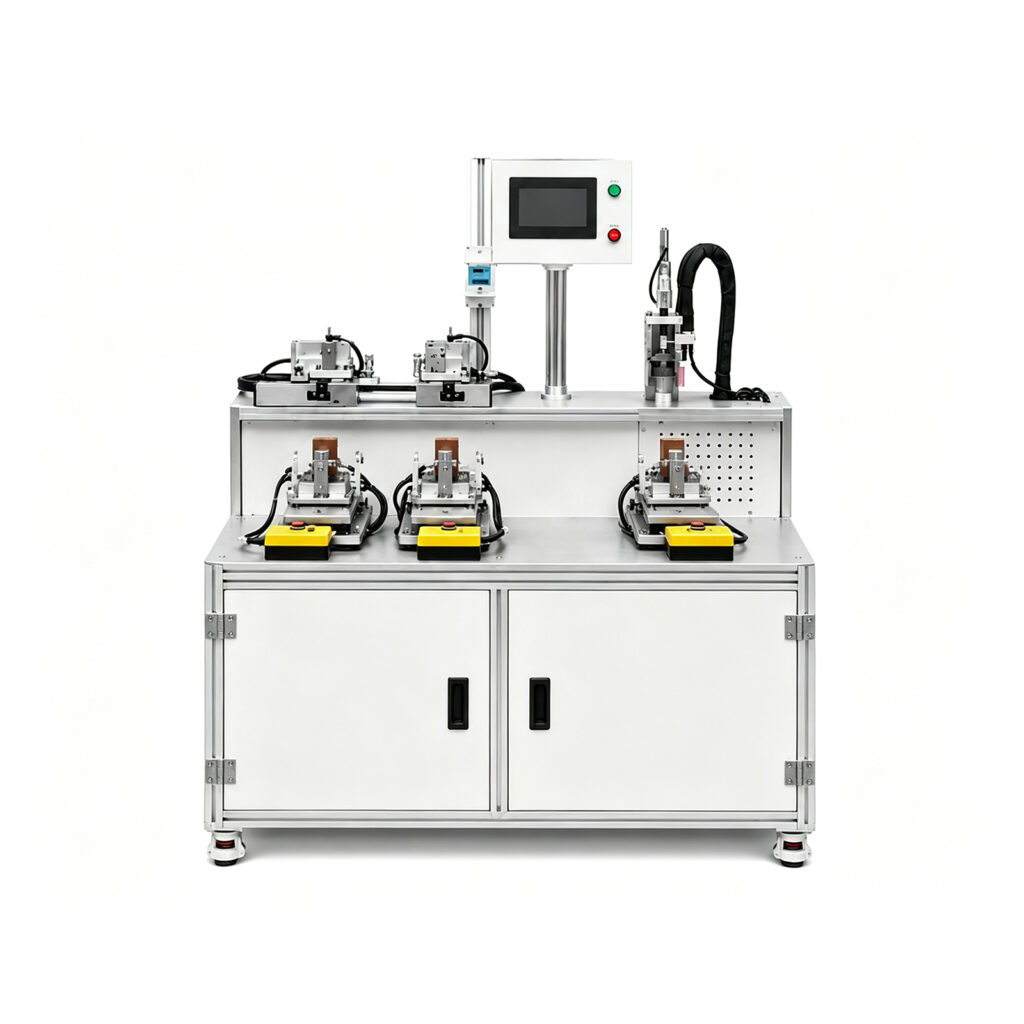
Introducing the Vapor Chamber Fully automatic laser sealing machine, your solution for precision and efficiency in advanced thermal management manufacturing.
With increasing power density in electronic products, the thermal management issue encountered by manufacturers is becoming more and more severe. To solve vapor chamber production technology has become more and more important.
Heat pipes generate heat by evaporation and release heat by condensation. The advantage of vapor chambers is also that their structure is relatively small.
However, to manufacture vapor chambers, there will be welding points, sealing points to be considered, and stability of the production process.
If there are tiny leaks during sealing, it may cause problems such as vacuum leakage and poor thermal conductivity. As a result, manufacturers are beginning to look for advanced sealing equipment.
Fully automatic laser sealing is a sealing equipment that integrates precision laser welding, flexible positioning machine, intelligent parameter control system.
In addition, you can help manufacturers increase production consistency and reduce hand-touch. This thermal management manufacturing equipment supplier introduces you to linkthermal.
linkthermal specializes in the production of vapor chamber production equipment, heat pipe manufacturing systems, and various supporting thermal processing equipment.
Plus, linkthermal can also guide you to choose equipment based on products and production processes, and the degree of intelligence needed.
Please click linkthermal to learn about the available machines.
1. What Is Vapor Chamber Fully automatic laser sealing machine?
A Vapor Chamber Fully automatic laser sealing machine applies laser energy to form sealed metal joints.
The system facilitates sealing processes applied during vapor chamber production.
Unlike traditional welding machinery, laser sealing equipment focuses energy to the area to be joined.
As a result, users can produce small weld beads with reduced heat input.
Additionally, automated movement maintains consistent welding trajectories.
Many systems offer several capabilities, such as:
Automatic loading
Precise product positioning
Lasers welding/sealing
Programmable movements
On-machine process monitoring
Automatic product unload
Recording production data
Keep in mind that actual features vary based on the configured system.
Users typically employ vapor chamber sealing machines when producing copper vapor chambers and other thermal components. Thermal vias can be welded during this process as well.
Heat pipe manufacturing also benefits from the appropriate laser sealing solution.
In summary, vapor chamber automatic laser sealing machines are vital to thermal processing.
2. How Does Automatic Laser Sealing Machine Work?
Automatic laser welding joins metal parts using concentrated light energy. Here is a brief overview of the laser sealing process:
Users enter the desired weld settings into the control interface.
An automatic feeding mechanism transports the parts to the welding zone.
Once in place, clamps hold the pieces at the correct location.
The laser head traces the programmed welding path.
The focused laser beam creates a small molten pool at the joint.
The molten solder solidifies, creating a seal.
The machine completes the welding cycle and moves the welded part towards exit.
Main Working Principles
Laser source
The laser generator creates a focused beam of light. As a result, the laser applies concentrated thermal energy to a small area.
Motion control
Servo motors allow users to control the motion of either the welding head or workpiece. In some cases, fixtures provide additional support to ensure proper alignment.
Welding control
A control system monitors and adjusts welding speed, laser power, and machine movement.
Thus, manufacturers can reproduce the same weld consistently over time.
Quality assurance
Visual inspection systems allow users to verify weld quality. Variables such as bead geometry and color may be assessed. However, technicians should also conduct leak tests to verify weld integrity.
3. What Are the Main Components of Fully Automatic Laser Sealing Machine?
Fully automated laser welding machines use several technologies to produce welds. The following sections briefly describe the components of a laser sealing system.
3.1 Laser Welding Source
Lasers produce the energy that melts metal parts together.
When deciding on a laser source, material type and thickness play a significant role in the decision process. However, laser wavelength, power density, and beam quality also play a crucial role.
3.2 Precision Motion System
Motion systems allow the movement of welding head or workpiece. Servo motors enable precise incremental motion on desired axes.
Guideways provide precision and repeatability of motion.
3.3 Automatic Feeding System
Material feeders bring parts to the welding station.
As a result, operators can avoid time-consuming manual tasks.
Automatic feeders also allow for synchronized production cycles.
3.4 Workpiece Positioning Fixtures
Positioning fixtures hold the workpiece in place during the welding process.
In many cases, fixtures prevent movement and displacement of the workpiece.
The material and shape of fixtures can affect thermal conductivity during welding.
3.5 Laser Welding Head
The welding head allows the laser to reach the work area.
Depending on the configuration, welding heads may also include laser focusing lenses. Additionally, some welding heads use cameras to assist with part positioning.
3.6 PLC Control System
Many laser welding machines use PLC control systems.
Typically, the PLC is responsible for machine movements, feeding, laser operation, and safety interlocks. Additionally, human-machine interfaces allow users to adjust process parameters.
3.7 Cooling System
Heat is generated during laser welding. As a result, cooling systems are necessary to maintain a stable operating temperature.
3.8 Safety Protection System
Lasers can be dangerous to operate. As such, manufacturers should install proper enclosures, interlocks, fume extraction, and emergency stops.
4. Vapor Chamber Laser Sealing Process
Ensuring a good seal requires proper setup and tight process control. The following steps outline the laser sealing process:
Step 1: Material Preparation
Begin by preparing your copper vapor chamber components.
Next, clean the surfaces of foreign materials and debris.
Clean surfaces ensure a reliable weld between components.
Step 2: Product Positioning
Feeding equipment brings the copper vapor chamber into the welding station.
Positioning equipment clamps the vapor chamber in place.
Correct part alignment ensures the weld geometry is consistent.
Step 3: Parameter Configuration
Select appropriate laser welding parameters.
Important parameters may include power, speed, focus depth, and assist gas. Consider running a validation weld to ensure settings are correct.
Step 4: Automatic Laser Welding
The laser tracing the CNC controlled welding path.
Energy is applied to join the two metal pieces together.
During this process, the control system regulates both motion and laser power.
Step 5: Cooling and Stabilization
Once welding is complete, the joint will need time to cool down.
Cooling the joint prevents Warpage and distortion.
Step 6: Weld Inspection
Visual inspection systems review the weld seam for defects.
You may also want to inspect the weld bead geometry and surface flaws.
Consider using machine vision to record process data as well.
Step 7: Leak Testing
Lastly, perform leak testing on your welded joint.
Leaks will determine if a weld fails to meet specifications.
As a result, you can weed out defective parts before they continue through production.
5. Key Benefits of Vapor Chamber Fully automatic laser sealing machine
5.1 Precision Welds
Lasers focus energy into a small area. With enough power, you can create small weld beads with little to no heat input. Automated movements ensure the weld path is consistent.
5.2 Increases Production Efficiency
Automatic loading and positioning features minimize manual tasks.
As a result, your operators can maximize efficiency during production.
5.3 Configurable Welding Parameters
Many machines allow operators to adjust welding parameters.
Coupled with some control systems, you can store process variables for future use.
5.4 Small Welding Zone
Typically, laser welding does not require as much heat to the surrounding area. Compared to other welding techniques, you can reduce the heat applied to the workpiece.
Keep in mind that welding distortion is affected by many different variables.
5.5 Process Data Monitoring
Certain machines come equipped with process monitoring capabilities.
You can even integrate your own inspection systems to meet your requirements.
5.6 Versatile Design
If your fixture and CNC program allow, you can produce many different vapor chamber designs.
As such, you can use the same machine to produce multiple products.
6. Technical Specifications and Selection Tips
The exact technical specifications vary from machine to machine.
Machine size will vary depending on part size, thickness, and production volume. Always verify specifications before purchasing a machine.
Parameter | Selection Considerations |
Laser Type | Fiber laser or another suitable laser technology |
Laser Power | Based on copper thickness and joint design |
Welding Method | Continuous or pulsed operation |
Control System | PLC and HMI |
Motion System | Servo-controlled axes |
Positioning Accuracy | According to product tolerances |
Feeding Method | Automatic or customized feeding |
Cooling System | According to laser requirements |
Welding Speed | Based on validated process parameters |
Applicable Material | Copper and other compatible metals |
Inspection | Visual, process monitoring, and optional leak testing |
Automation | Standalone or production line integration |
Please note: This table is intended to outline selection criteria, not specific tested specifications for any one linkthermal model.
7. Benefits of Automation
7.1 Increased Production Throughput
Operators do not have to manually handle components every cycle.
Programmable weld paths allow for repeatable cycle times.
Overall production throughput can be increased by reducing the amount of manual labor.
7.2 Increased Process Stability
Digital controls allow the system to run to preset process parameters.
Manufacturer’s can minimize the variability caused by human operators.
7.3 Minimized Warpage
The laser fusion zone is typically small and localized to the joint region.
By properly selecting the laser welding parameters, thermal input can be minimized.
This can help to reduce warpage in some manufactured parts.
7.4 Increased Traceability
Advanced controllers have the ability to track welding parameters and production data.
Data can be used to review production trends and maintain quality standards.
7.5 Lower Labor Costs
Automated component feeding, positioning, and welding eliminates the need for operators to perform these tasks.
Operators can focus on overseeing the production process and ensuring quality standards are met.
7.6 Streamlined Manufacturing
Since laser welding paths can be programmed, multiple product geometries can be built into the controller.
If necessary, tooling can be designed to allow quick product changeovers.
8. Laser Sealing in Thermal Management Manufacturing Processes
8.1 Vapor Chamber Production
To function properly, vapor chambers must have a completely sealed enclosure.
Precision laser welding is ideal for this type of critical sealing operation.
Automated laser sealing ensures repeatable and reliable production.
8.2 Heat Pipe Production
Heat pipes often require precision welding or sealing at the end caps.
Therefore laser welding can be used in the production of certain heat pipes.
8.3 CPU Cooling
High performance CPUs require efficient heat spreading solutions to manage heat density.
Vapor chambers are used in some CPU cooling solutions to help spread heat.
8.4 GPU Cooling
Graphics processing units (GPUs) can produce a lot of heat when under heavy loads.
Vapor chambers are used in some GPU cooling solutions to help spread the heat across a larger surface area.
8.5 AI Server Cooling
AI servers often utilize high power CPUs and GPU like accelerator modules.
Like high performance computing, AI server cooling also relies on efficient heat spreading to manage high heat fluxes.
8.6 Electronic Devices
Many consumer electronic devices have a small form factor with limited space for cooling solutions.
Vapor chambers can be used in some electronic devices to help cool sensitive components.
9. Laser Sealing Compared to Other Sealing Methods
Joining Methods: There are many methods to join two or more parts together.
Feature | Laser Welding | Brazing | Resistance Welding |
Heat input | Highly localized | Broader heating | Localized at contact |
Joint precision | High potential | Process-dependent | Electrode-dependent |
Automation | High potential | High potential | High potential |
Filler material | Often unnecessary | Commonly required | Often unnecessary |
Tooling | Precision fixtures | Heating fixtures | Electrodes and fixtures |
Copper compatibility | Requires process optimization | Depends on filler and process | Requires suitable parameters |
Hermetic sealing | Requires validation | Requires validation | Requires validation |
Why Use Laser Sealing?
Firstly, laser welding allows for localized energy input.
Secondly, programmed motion allows for complex welding paths.
Also, the right laser system can allow for automated manufacturing.
However, laser welding will not inherently create leak-proof joints.
As such, manufacturers should verify every sealing operation against their design specifications.
10. Integrating With Vapor Chamber Production Lines
Every laser sealing machine can act as a standalone manufacturing station.
However, manufacturers can integrate them into a larger production line as well.
A Standard  Vapor Chamber Production Line Could Include:
- Copper Plate Forming Machine
- Vapor Chamber Cleaning Machine
- Vapor Chamber Powder Filling Machine
- Vacuum Sintering Furnace
- Vapor Chamber Hot Press Hydraulic Machine
- Vapor Chamber Laser Welding Machine
- Vapor Chamber Vacuum Degassing Machine
- Vapor Chamber Filling Machine
- Vapor Chamber Thermal Performance Tester
The order of each process will vary based on chamber design and manufacturing methods.
For instance, some products need perimeter welds completed before vacuum filling. While others may use a secondary sealing operation after filling is completed.
As a result, manufacturers shouldn’t consider enclosure welding and final evacuation-port sealing the same thing.
Also, if manufacturing stations are compatible, automated transfer mechanisms can move materials from station to station.
As a result, connected equipment can limit material handling and production bottlenecks.
11. Factors That Affect Laser Sealing Quality
11.1 Surface Condition of Materials
First off, copper surfaces should meet a certain level of cleanliness.
Surface contaminants can affect laser absorption and weld integrity.
As a result, manufacturers should identify repeatable cleaning methods.
11.2 Laser Power
More laser power means more heat input and weld penetration.
However, too much power can cause excess melting or even damage the material.
As a result, manufacturers need to find the proper power setting.
11.3 Welding Speed
Welding speed determines how much energy is distributed across the weld joint.
As such, manufacturers need to balance welding speed with their weld penetration needs.
11.4 Focus Position of Laser
The focus position of the laser will affect how concentrated the laser’s energy is.
Moreover, having a consistent focus will allow for repeatable weld conditions.
11.5 Accuracy of Fixture
Any movement in the work piece can lead to dimensional issues in the weld.
Therefore, a good fixture that limits movement is crucial to seal quality.
11.6 Shielding Conditions
Providing the proper shielding gas can help prevent material oxidation during welding.
Therefore, engineers should consider what shielding is necessary for their process and material.
11.7 Inspection of Final Seal
Lastly, manufacturers should perform some sort of weld inspection and seal verification.
Moreover, proper leak testing ensures that the products meet their intended specifications.
12. How to Select the Best Machine for your Application
Picking the right laser sealing machine can seem daunting. However, with these steps, manufacturers can easily select the machine that best fits their needs.
First, manufacturers should know the dimensions and material they will be working with.
Next, they should know how many they plan to produce per day and the quality that is required.
Factors to consider when selecting the best vapor chamber laser sealing machine
Product dimensions:Working area and fixture capabilities
Material Thickness: Laser system selection is based on material thickness and what you need joined
Sealing Method: Look for perimeter welding, filling-port sealing, or other types of closure operations your product needs
Production Requirements: Know how many seconds per piece and how many pieces you need per day your production line will need to meet
Degree of Automation: Understand what aspects of the process you need automated feeding, welding, part positioning, and unloading
Quality Expectations: Do you need a machine vision system to monitor your welds? What about leak testing the chambers after welding
Factory Space: Do you have enough room? What about all the necessary utilities and neighboring equipment your new machine will need to interface with
After Sales: Technical support after buying the machine. Do they provide installation and commissioning? Do they provide training on how to use the machine
Another tip would be to ask to do some sample welds with the machine you plan on buying. Once you receive your sample parts you can better determine if the machine is right for your application.
13. Why Choose linkthermal?
When selecting a vendor to purchase your equipment from can help ease the integration process of your new equipment.
linkthermal specialises in thermal management manufacturing equipment & production lines.
linkthermal’s customers are manufacturers who design and produce vapor chambers, heat pipes, and other thermal components.
Customized Manufacturing Equipment Solutions
linkthermal will go over equipment configurations with you and your team. Some things to discuss would be your product dimensions, sealing process types, and your expectations for automation.
Thermal Component Manufacturing Equipment
linkthermal specializes in equipment used for manufacturing thermal components. Other equipment types linkthermal can provide include:
Vapor Chamber Processing Equipment
Heat Pipe Manufacturing Equipment
Heat Sink Processing Equipment
Planning Out Your Production Line
Many times, you will need multiple machines that can work together across different stages of production. By planning out your production line, linkthermal will help you limit complications between different pieces of equipment.
Technical Communication
As a customer, you can always send linkthermal your product drawings and specific manufacturing requirements.
That way linkthermal can help advise you on what equipment would best suit your needs.
Assisting You in Selecting the Best Equipment
In conclusion, there are many different pieces of equipment to choose from when building your production line. Make sure to do your research on specifications, ask for sample parts, and discuss your options with linkthermal. Visit us at https://linkthermal.com/.
14. Maintenance and Quality Control Measures
Performing regular maintenance on the machine will allow it to consistently operate. Below are some maintenance techniques that will allow your equipment to have a long life.
Daily Maintenance
Inspect the machine for any leftover debris from the previous days production.
Inspect fixtures, safety features, and ensure the machine is in ready to work condition.
Lastly, Inspect any optical filters that are easily reachable.
Weekly Maintenance
Inspect any moving parts and connections.
Furthermore, take a look at your cooling system and ensure there are no weird alarms coming from the machine.
Monthly Maintenance
Refer to the maintenance chart that came with the machine.
Also, have trained technicians inspect any laser components and electrical connections.
Quality Control Measures
Just like there are maintenance steps you should follow, there are also steps to ensure you are producing quality vapor chambers.
First, ensure your process variables are within the proper ranges.
Some things to look at would be laser power, welding speed, part positioning, and weld appearance.
Second, perform leak tests on your chambers. By doing this you can ensure your chambers meet the specifications they need to.
15. Future Outlook of Vapor Chamber Laser Sealing Technology
As electronic continue to push the limits of heat dissipation. Newer and better methods of manufacturing efficient thermal components will evolve.
Industrial Weld Monitoring
Industrial lasers will begin to keep logs of process data.
Not only that, but there will be tools to help detect when an weld may be faulty.
Lean Manufacturing
Factories will begin to become more automated with less need for man power.
As a result, you will see more material handling machines working between processing stations.
New Laser Processing Methods
There are always new and innovative ways to process metal with lasers.
One thing to look for is different laser wavelengths and beam shapes.
The different wavelengths and shape can affect how your material absorbs the laser.
Thin Vapor Chambers
As technology evolves, handheld technology will become more prominent.
As a result, thin vapor chambers will need to be manufactured with precision.
16. FAQ
16.1 What is Vapor Chamber Fully automatic laser sealing machine?
A Vapor Chamber Fully automatic laser sealing machine is used to conduct weld and sealing operations when manufacturing vapor chambers. Additionally, these machines have automatic controls which allow for repeatable positioning and welding processes.
16.2 Why do Vapor chambers need to be well sealed?
Since vapor chambers function by maintaining specific internal conditions and allowing a working fluid to transfer heat. Any leaking substances or foreign gases can hinder thermal performance.
16.3 Can laser sealing machines seal copper vapor chambers?
Yes, laser sealing machines have the capabilities to weld copper. However, one needs to set the laser parameters according to the thickness of their specific material.
16.4 Is automatic laser sealing superior to manual laser welding?
Using an automatic laser sealing machine can increase process reliability and minimise repetitive strain on workers.
However, it truly depends on the machines configuration and if the welding parameters have been tested and proven.
16.5 Can the Vapor Chamber Laser Sealing machine be integrated into a vapor chamber production line?
Yes, depending on the other equipment your using. Machines can be connected with automatic material handling systems.
Additionally, every machine has different requirements for integration. It all depends on how your factory is layout and what interfaces the machines use.
16.6 Will laser sealing guarantee a chamber will be sealed correctly?
Laser sealing will not ensure your chamber is sealed correctly.
Your still going to need to inspect your welds to ensure they meet the criteria your looking for.
16.7 What determines the price of a laser sealing machine?
Prices are determined by the laser used, how automated it is, work area size, control system, and if there’s a machine vision system.
Because of this, we recommend asking for a quote with your specific needs in mind.
16.8 How can laser welding consistency be improved?
First, they could ensure the surface of the material is clean and parts aren’t moving during welding. Next, they should verify the laser parameters and monitor for process drift. Lastly, regular maintence will ensure your machine is always running as intended.
16.9 Does linkthermal offer custom laser sealing machine solutions?
Yes, linkthermal can sit down with you and discuss what thermal equipment you’re looking for.
Moreover, by providing linkthermal with your product drawings and specific manufacturing needs. They will be able to advise you on what equipment will suit your needs best.
16.10 Where can I find vapor chamber processing equipment?
You can find vapor chamber processing equipment at linkthermal.com!
Visit our website to learn more about our machinery and services.
17. Closing Thoughts
A Vapor Chamber Fully automatic laser sealing machine is capable of producing precision welds when manufacturing vapor chambers. The laser allows for a concentrated heat source while programmable motion allows for automation of the process.
On top of this, automatic controls help improve part-to-part consistency. However, just because your using a laser sealing machine doesn’t mean your chambers will be properly sealed.
You should always have your chambers inspected to ensure they meet your needs. linkthermal specializes in thermal management processing equipment and full production lines.
linkthermal provides vapor chamber machines, heat pipe processing equipment, and much more. linkthermal can also provide you with custom equipment to fit your needs.
Whether that is just a single machine or an entire thermal processing production line.
Home